
Ice plant care is surprisingly simple when the plant has two things it cannot negotiate: strong sunlight and excellent drainage. Most hardy Delosperma types prefer a dry-to-moderate watering pattern, gritty or sandy soil, and enough direct sun to keep their low mats compact and flower-filled.
The catch is the name. “Ice plant” isn’t one botanical species, so the right care depends on whether you’re growing Delosperma, Carpobrotus, Lampranthus, Mesembryanthemum, or another plant sold under that common name.
Editor’s note: Rather than inventing a personal garden story, this guide uses horticultural observations and independently verified plant data. That keeps the advice factual instead of pretending the author personally grew a particular cultivar.
Ice Plant Care at a Glance
| Care Factor | Best Starting Point |
| Light | Full sun; aim for roughly 6+ hours of direct light |
| Water | Let the growing medium dry substantially between drinks |
| Soil | Sandy, gritty, rocky, sharply draining soil |
| Temperature | Depends heavily on species and cultivar |
| Humidity | Average outdoor humidity is usually fine; stagnant wet conditions are the bigger concern |
| Toxicity | Depends on the exact plant; verify the botanical name |
| Difficulty | Easy once drainage and sunlight are right |
| Best Use | Rock gardens, dry borders, slopes, containers, and low-water landscapes |
Start With the Plant’s Botanical Name
Before changing your watering routine, look at the nursery tag.
If it says Delosperma, you’re generally dealing with the low, mat-forming succulent ground covers most gardeners mean when they search for hardy ice plants. Delosperma cooperi, for example, is listed by the Missouri Botanical Garden as a full-sun perennial suited to dry, sharply drained soil, with a typical height of about 3–6 inches and a spread of roughly 1–2 feet.
But the label might instead say Carpobrotus edulis, Lampranthus, or Mesembryanthemum. Those aren’t interchangeable.
This distinction is one of the most useful pieces of ice plant care because the common name tells you surprisingly little about the plant’s eventual behavior.
Light Requirements
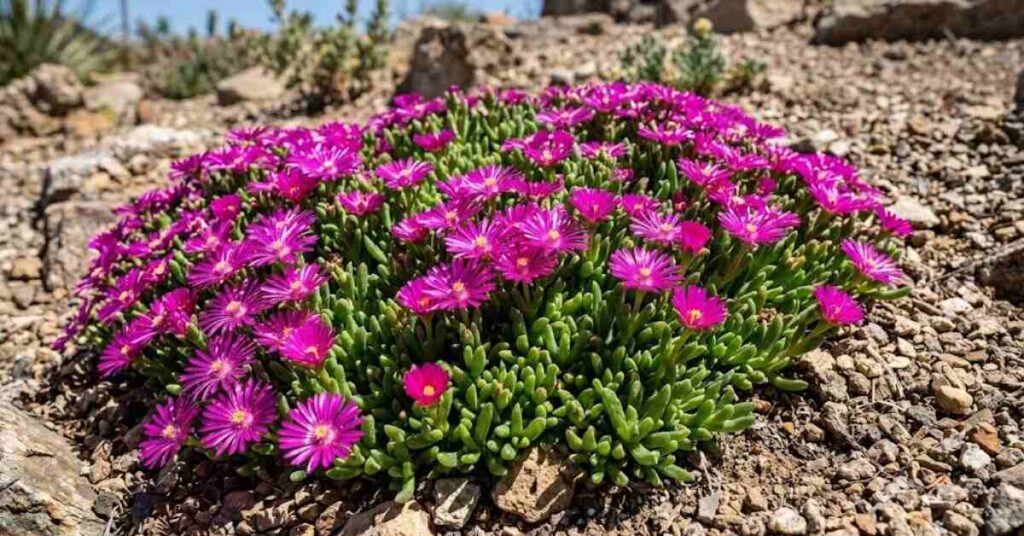
Give hardy Delosperma the brightest outdoor position you have.
A site receiving around 6 or more hours of direct sun is a strong starting point, especially if your goal is a dense carpet covered with flowers rather than stretched foliage.
Plants grown with inadequate light tend to become less compact and produce fewer flowers. Full sun also suits the plant’s natural preference for exposed, dry growing conditions.
A useful placement test
Watch the planting area for one sunny day.
If a wall, tree, fence, or building blocks direct sunlight for most of the afternoon, don’t automatically assume the plant will perform like one growing in an open rock garden. A spot that looks “bright” to your eyes can still be relatively dim from a succulent’s perspective.
Best locations include:
- South- or west-facing borders
- Gravel gardens
- Rockeries
- Sunny retaining-wall edges
- Dry slopes
- Containers on bright patios
- Narrow strips where turf struggles from heat
Choosing Soil That Drains Before It Dries
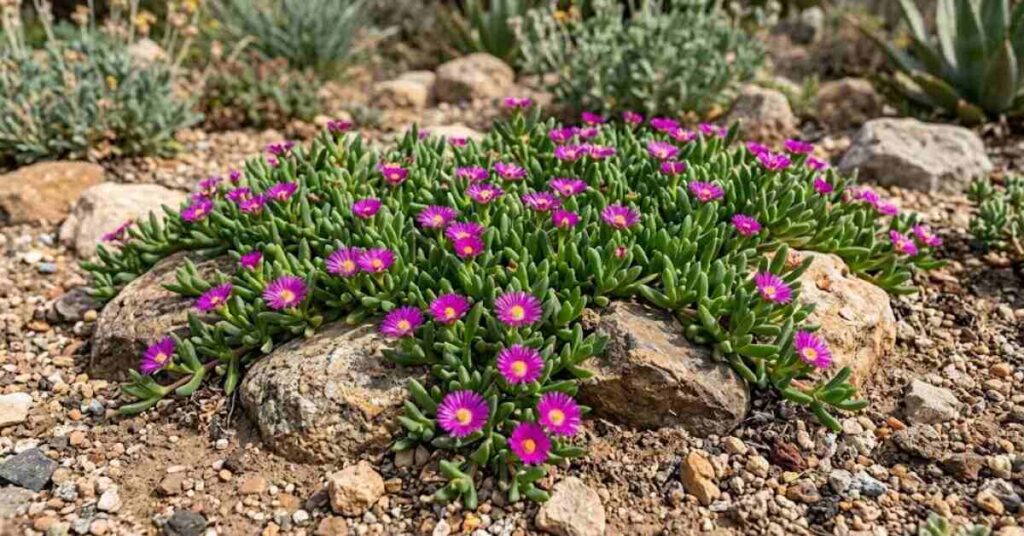
For ice plants, the most important soil characteristic isn’t richness. It’s how quickly excess water can leave the root zone.
Heavy clay creates a particularly difficult combination: the surface may look dry while the deeper soil remains saturated. That can be disastrous for a succulent ground cover during cool or wet periods.
Missouri Botanical Garden specifically warns that poorly drained soil can cause Delosperma cooperi to perform badly or die, while Delosperma nubigenum is similarly described as requiring good drainage, particularly through winter.
A practical soil mix for containers
For a potted ice plant, start with a cactus/succulent-style growing medium rather than a moisture-retentive houseplant mix.
A simple approach is:
- 2 parts quality potting mix
- 1 part coarse perlite or pumice
- 1 part coarse horticultural grit
The exact ratio isn’t sacred. The finished medium should collapse into neither mud nor a dense peat brick after watering.
Drainage matters more than fertilizer
If your soil is naturally sandy or rocky, resist the temptation to turn it into a rich flower-bed mix.
Ice plants are adapted to conditions where excess fertility isn’t necessary. Garden Design likewise recommends lean, well-drained growing conditions and notes that ice plants generally need little or no supplemental fertilizer.
Watering Established Ice Plants
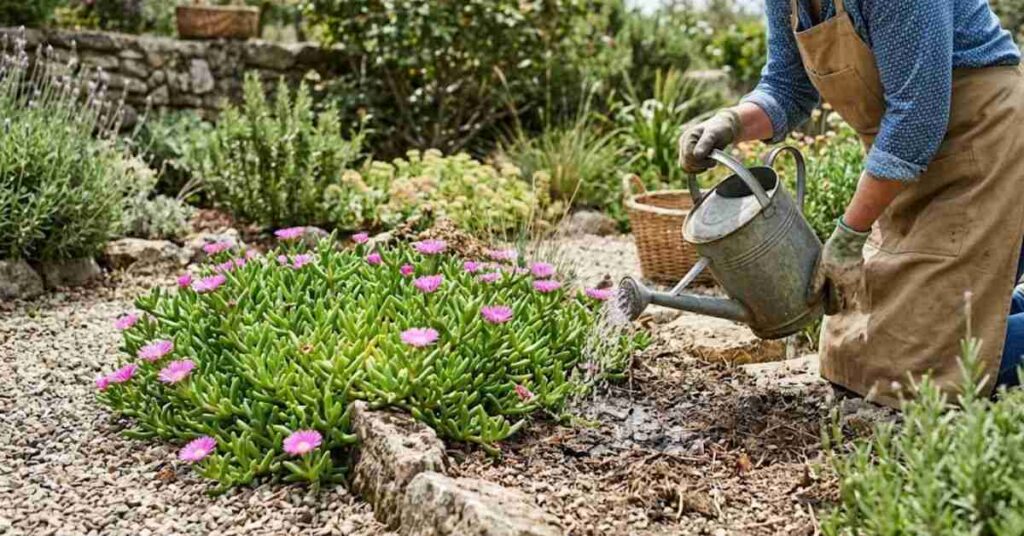
The easiest mistake with an ice plant is treating it like an ordinary flowering perennial.
Its fleshy foliage stores water, so the plant doesn’t need a constantly damp root zone.
Instead of following a rigid calendar, use the soil and weather as your guide.
Newly planted ice plants
Fresh transplants need more attention while their roots are spreading into surrounding soil.
Water thoroughly after planting, then allow the upper portion of the growing medium to dry before watering again. During extended hot, rainless weather, newly planted specimens may need additional irrigation.
Established plants
Once the root system has settled in, drought is usually less dangerous than persistently wet soil.
During a prolonged dry spell:
- Test the moisture levels a few inches down into the soil.
- If it has dried substantially, water deeply enough to wet the root zone.
- Let excess water drain away.
- Don’t automatically repeat the process the next morning.
Container plants are different because their small volume of soil can dry much faster than a garden bed.
Winter watering
Cold weather changes the equation.
If your ice plant is outdoors during a cool, rainy winter, avoid adding irrigation simply because it has been several days since you last watered. Wet soil plus cold temperatures is a much more serious combination for many Delosperma plants than a brief dry spell.
Temperature and Hardiness
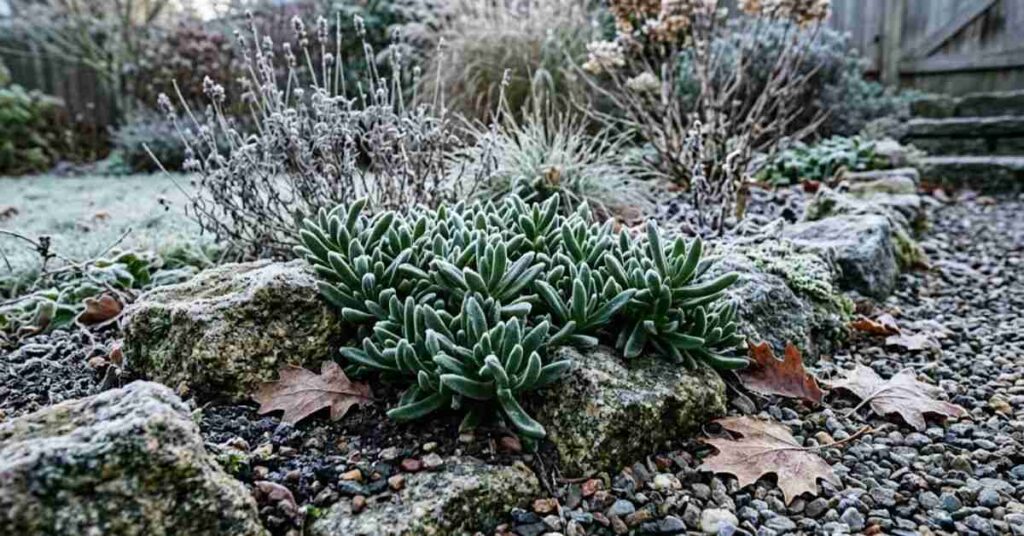
There is no single hardiness zone for every ice plant.
This is another reason to identify the cultivar before buying a plant based on a generic zone number.
For example:
- Delosperma cooperi is listed by Missouri Botanical Garden for Zones 6–10.
- Delosperma nubigenum is listed for Zones 6–8.
- Some named Delosperma selections can tolerate colder conditions than others.
- Carpobrotus and warm-climate ice plants have different expectations.
Missouri Botanical Garden also notes that winter survival can become unreliable in regions where wet winter soil combines with cold temperatures.
The important lesson
Cold tolerance isn’t just about the thermometer.
A plant sitting in dry, sharply drained soil may survive a cold spell that would damage the same cultivar planted in a soggy depression.
For winter-prone areas, raised beds, rock gardens, slopes, and gravelly planting pockets can be safer than flat areas where rainwater collects.
Humidity and Airflow
Ice plants don’t need greenhouse-level humidity management.
The bigger concern is persistent moisture around the plant, especially when humidity is paired with poor drainage and limited airflow.
That means a humid climate doesn’t automatically rule out ice plants. Instead, choose a location where:
- Rainwater doesn’t pool.
- Soil drains quickly.
- Foliage isn’t packed against constantly wet vegetation.
- The plant receives strong sunlight.
- Irrigation doesn’t keep the root zone perpetually damp.
In other words, don’t try to make the plant “comfortable” by increasing moisture. For a succulent ground cover, that can create the exact conditions that cause trouble.
Flowering and Bloom Performance
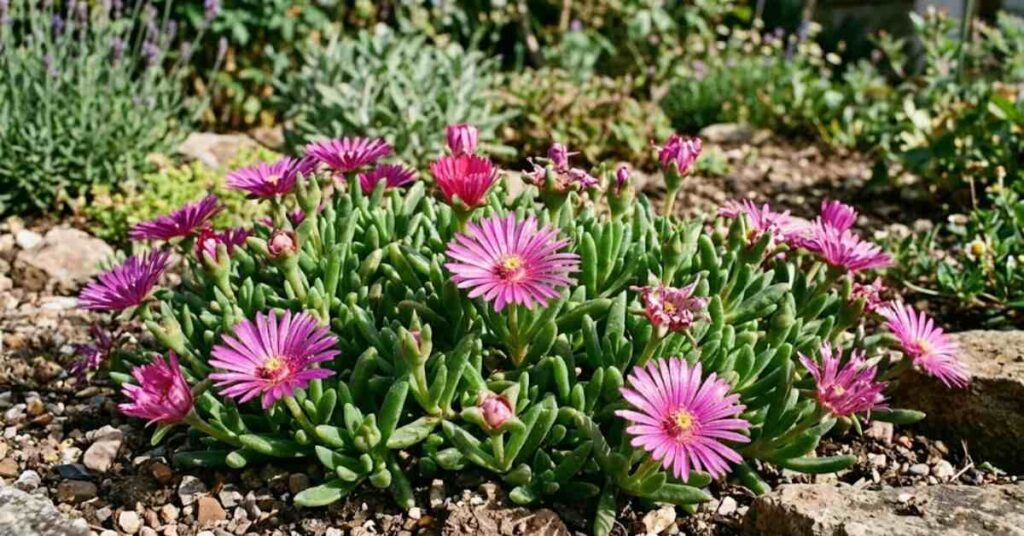
A healthy ice plant can transform from an understated green ground cover into a carpet of bright flowers.
Depending on the species or cultivar, flowers can appear in shades including:
- Magenta
- Purple
- Pink
- Yellow
- White
- Orange
- Bi-color combinations
Delosperma cooperi, for example, is documented as producing glossy red-purple flowers and blooming from June into September in the Missouri Botanical Garden’s plant profile.
How to encourage more flowers
Focus on the basics rather than heavy feeding:
More direct sun + better drainage + restrained watering = better flowering conditions.
If a plant is producing lots of soft green growth but disappointing flowers, inspect light exposure first. Adding fertilizer is not necessarily the solution.
Fertilizing Ice Plants
Fertilizer should be a minor part of your routine.
For an established Delosperma growing in ordinary outdoor soil, you may not need regular feeding at all.
If the planting medium is exceptionally poor or the plant is being grown in a container with a depleted mix, a light spring feeding can be reasonable.
Avoid turning an ice plant into a high-nitrogen project. Excessively lush growth isn’t the goal; compact growth and reliable flowering are.
Planting Ice Plant in the Landscape
Ice plants shine where many thirsty plants struggle.
Good locations include:
- Rock gardens
- Dry slopes
- Gravel borders
- Sunny flower-bed edges
- Retaining-wall pockets
- Coastal-style gardens
- Low-water landscape designs
- Containers
- Erosion-prone slopes where the selected cultivar is appropriate
Colorado State University Extension lists Delosperma selections among plants suited to rock gardens and dry, well-drained conditions.
Don’t plant it where people constantly walk
Although an ice plant forms a tough-looking carpet, that doesn’t make it a substitute for a walking lawn.
Use stepping stones through a planting rather than expecting the succulent mat to absorb repeated foot traffic.
The Ice Plant Name Trap: Identify It Before You Plant It
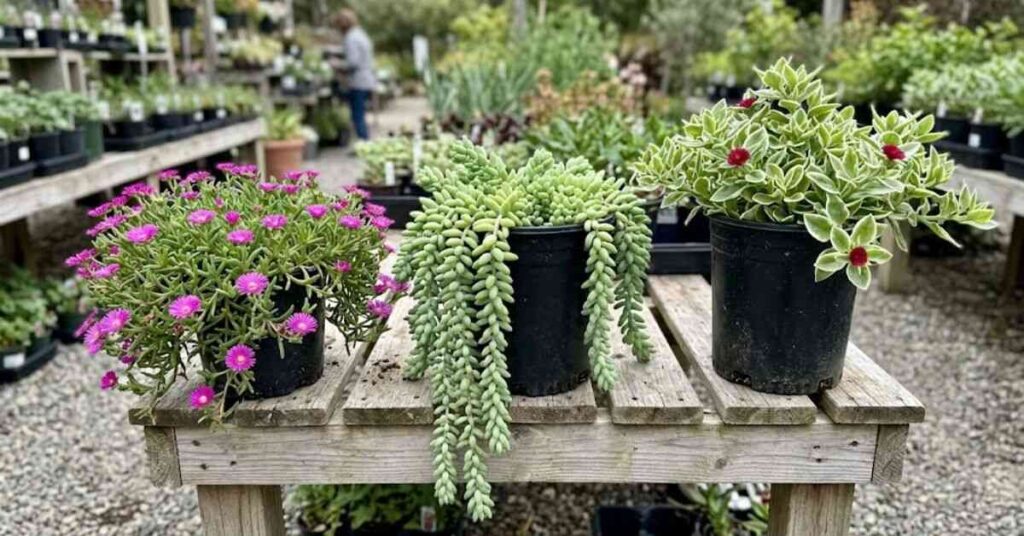
This is the distinction that deserves more attention than it usually gets.
1. Delosperma
Delosperma is the group most useful when you’re looking for hardy, low-growing succulent ground cover.
Many varieties form mats only a few inches tall while spreading considerably wider. Their flowers can be remarkably bright, making them useful along paths, in rock gardens, and on dry slopes.
Examples include:
- Delosperma cooperi
- Delosperma nubigenum
- Delosperma floribundum
- Named hybrids and cultivars such as ‘Mesa Verde’ and ‘Kelaidis’
RHS describes Delosperma as mat-forming perennials with fleshy leaves and brightly colored daisy-like flowers, while recommending full sun and good drainage.
2. Carpobrotus
Carpobrotus edulis is a completely different situation.
This vigorous trailing succulent is also called an ice plant, but it should not simply be lumped together with ornamental hardy Delosperma.
In regions such as coastal California, Carpobrotus edulis has a history of invasive behavior. The mistake is easy to make if you search only by common name.
If a nursery tag says Carpobrotus, check your local invasive-plant guidance before planting it.
3. Lampranthus
Lampranthus contains other flowering succulents that are also sold as ice plants. Their growth habit and climate tolerance can differ considerably from hardy Delosperma.
The ASPCA, for example, lists Lampranthus piquet specifically under the common name “Ice Plant” and classifies that plant as non-toxic to dogs, cats, and horses.
That does not mean every plant sold under “ice plant” has automatically been evaluated under the same name. Botanical identification still matters.
4. Mesembryanthemum
Some Mesembryanthemum species are also called ice plants and are commonly grown as flowering annuals or tender succulents.
Their care can differ from cold-hardy Delosperma, particularly in regions with freezing winters.
5. Hylotelephium
There’s another naming complication: Hylotelephium species can also be called ice plant, especially in British horticultural sources.
RHS describes Hylotelephium as succulent perennials that form upright clumps rather than the low creeping mats typical of Delosperma. They also have different seasonal behavior, including winter dieback.
The takeaway
If your plant tag simply says “Ice Plant,” don’t stop there.
Find the botanical name before making decisions about:
- Hardiness
- Winter survival
- Spread
- Invasive potential
- Flowering period
- Whether it is perennial or annual
- How much space it needs
That one step prevents a surprising number of ice-plant-growing mistakes.
Propagating Ice Plant
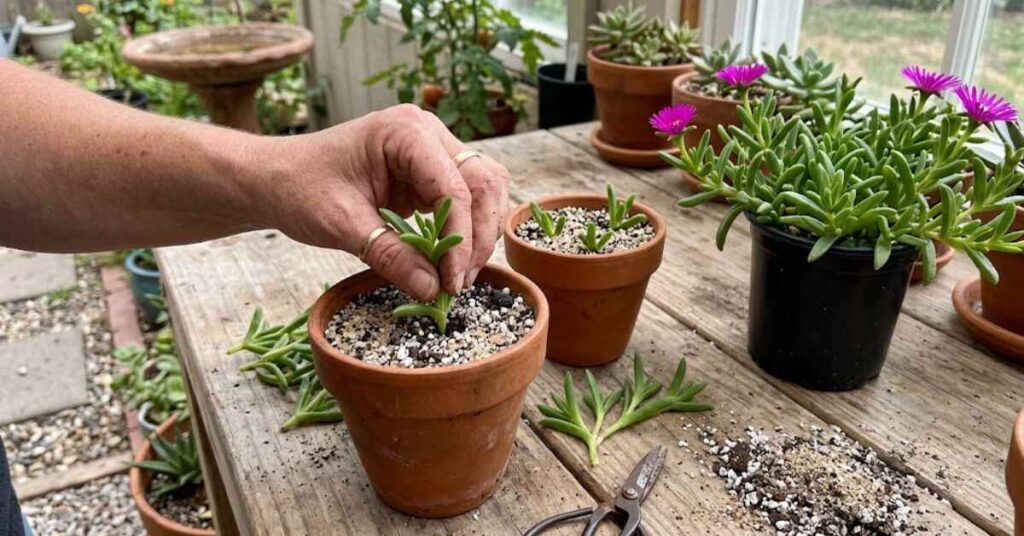
Ice plants can be propagated by several methods, depending on the type.
Stem cuttings
For many Delosperma cultivars, stem cuttings are a straightforward way to create additional plants.
Take a healthy section of non-flowering growth, allow the cut surface to dry briefly, and place it into a gritty, lightly moist propagation medium.
The goal is not to keep the cutting soaked. You’re encouraging roots while reducing the chance of rot.
Division
Established clumps can sometimes be divided when conditions favor active growth.
Spring is a useful window for many hardy perennial forms because the plant has the growing season ahead of it.
Seed
Seed works for suitable species, but named cultivars may not produce seedlings identical to the parent plant.
If you’re trying to reproduce a particular flower color or growth habit, vegetative propagation is usually the more predictable route.
Pruning and Seasonal Cleanup
Ice plants generally don’t need aggressive pruning.
Think of maintenance as selective cleanup rather than shaping a hedge.
In spring:
- Remove clearly dead winter-damaged material.
- Cut away damaged sections back to healthy growth.
- Clear debris that is trapping moisture around the crown.
- Let healthy new growth take over.
RHS notes that Delosperma ‘Mesa Verde’ requires no routine pruning, while other ice-plant types may benefit from removal of damaged material or post-flowering cleanup.
Don’t automatically shear the entire plant simply because another succulent guide recommends it. The correct approach depends on the species and its growth habit.
Common Problems & Fixes
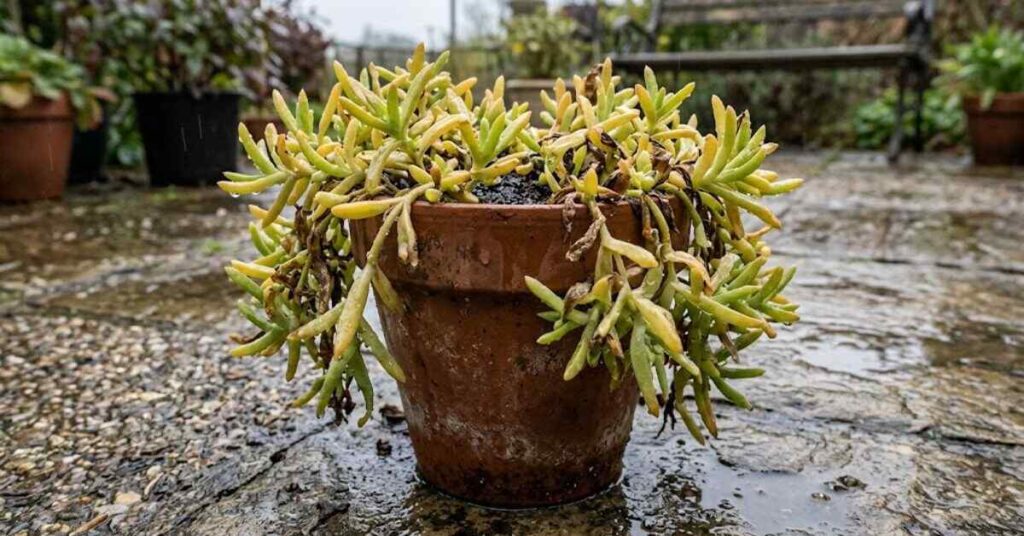
Yellowing leaves:
Start by checking moisture rather than assuming the plant needs fertilizer. If the soil stays damp for long periods, improve drainage and reduce irrigation.
Mushy stems:
This is a serious warning sign for a succulent. Inspect the root zone for excessive moisture and remove rotting tissue before the problem moves farther through the plant.
Lots of leaves but few flowers:
Look at sunlight first. A plant receiving weak or interrupted light may remain alive while flowering poorly.
Plant turns brown after winter:
Don’t immediately remove everything. Wait for the beginning of active spring growth and determine which stems are genuinely dead before cutting.
Plant collapses after heavy rain:
Poor drainage may be the underlying problem. Moving the plant to a raised or gravelly position can be more effective than simply changing the watering schedule.
Ice plant becomes stretched and sparse:
Insufficient light is a likely culprit. Move container specimens to a brighter location, or evaluate whether nearby structures are blocking direct sun.
Leaves shrivel during summer:
Some wrinkling during a prolonged dry period is normal for drought-adapted succulents, but persistent shriveling combined with completely dry soil can indicate that the plant needs a thorough watering.
Plant dies during a wet winter:
Cold plus saturated soil is a common danger zone. Improve drainage before the next winter rather than trying to compensate with more fertilizer or pruning.
Ice Plant in Containers
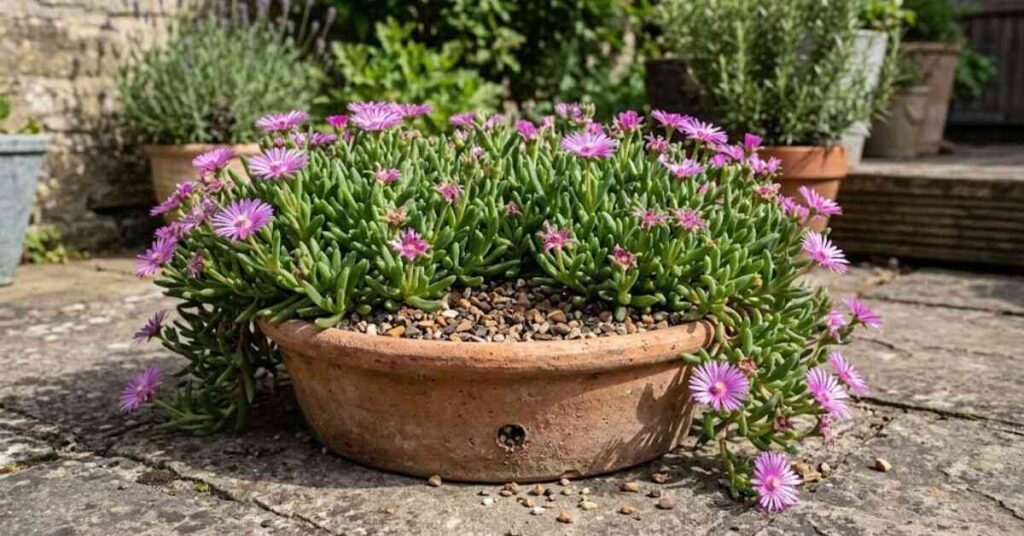
Containers are excellent for ice plants because you can control the drainage more easily than in heavy garden soil.
Choose a pot with a genuine drainage hole.
A shallow, wide container can work especially well for mat-forming Delosperma, allowing stems to trail over the edge rather than forcing the plant into a deep column of wet soil.
Container checklist
- Use a gritty, fast-draining medium.
- Make sure the drainage hole isn’t blocked.
- Place the container where it receives strong sunlight.
- Water thoroughly rather than giving tiny daily splashes.
- Allow the growing medium to dry substantially prior to rewatering.
- Move vulnerable cultivars to a protected location before severe winter conditions.
Unglazed clay pots can also be useful because their porous walls allow additional moisture loss, although drainage holes and the growing medium remain more important than the pot material itself.
Ice Plant as a Ground Cover
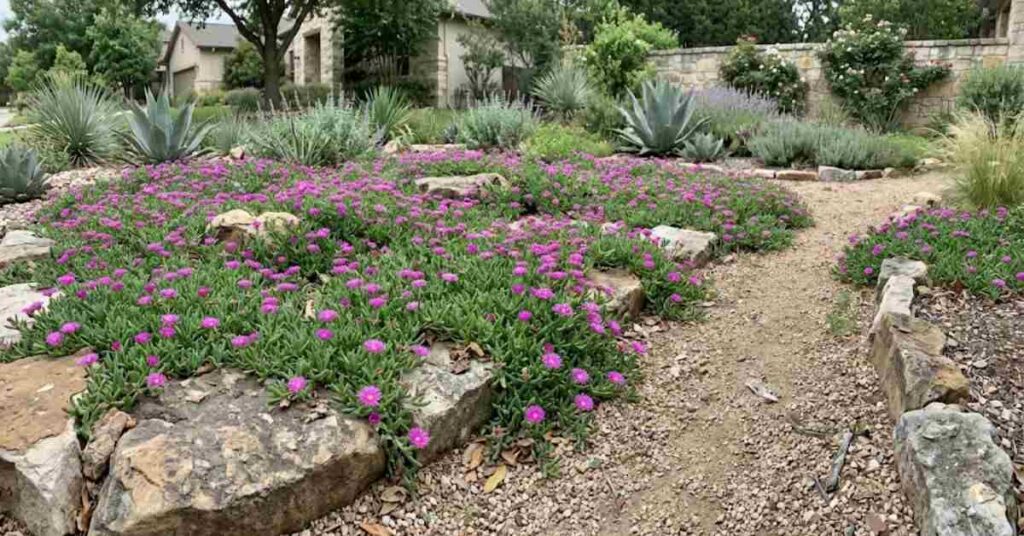
For the right site, an ice plant can act like a living layer of color rather than a traditional lawn.
Its low-growing habit makes it useful around:
- Rocks
- Boulders
- Dry-stacked walls
- Sunny borders
- Gravel pathways
- Slopes
- Raised succulent beds
The visual effect is strongest when the plant has room to spill naturally.
Rather than squeezing it between thirsty perennials, pair it with plants that appreciate similar conditions.
Good companions can include other drought-tolerant succulents, lavender, certain ornamental grasses, and rock-garden perennials that prefer strong sun and rapid drainage.
Is Ice Plant Good for Erosion Control?
Some Delosperma varieties can help cover exposed soil on slopes because their stems spread horizontally and can form dense mats.
But don’t treat every ice plant as a universal erosion-control solution.
The correct choice depends on:
- Slope angle
- Rainfall
- Soil type
- Winter conditions
- Local invasive-plant regulations
- The particular ice-plant species
For a steep slope receiving intense rainfall, structural stabilization may still be necessary. A ground cover should complement good site design, not replace it.
Fire-Resistant Landscaping: A More Careful Approach
Ice plants are sometimes marketed as fire-resistant or useful in fire-wise landscapes because they are succulent and contain substantial stored water.
However, “fire-resistant” does not mean “fireproof.”
Landscape fire behavior depends on plant moisture, spacing, maintenance, surrounding vegetation, wind, terrain, and the specific plant.
If you’re designing a defensible-space landscape, follow local fire authority or extension guidance rather than choosing plants solely because they are labeled fire-resistant.
Outdoor Ice Plant vs. Indoor Growing
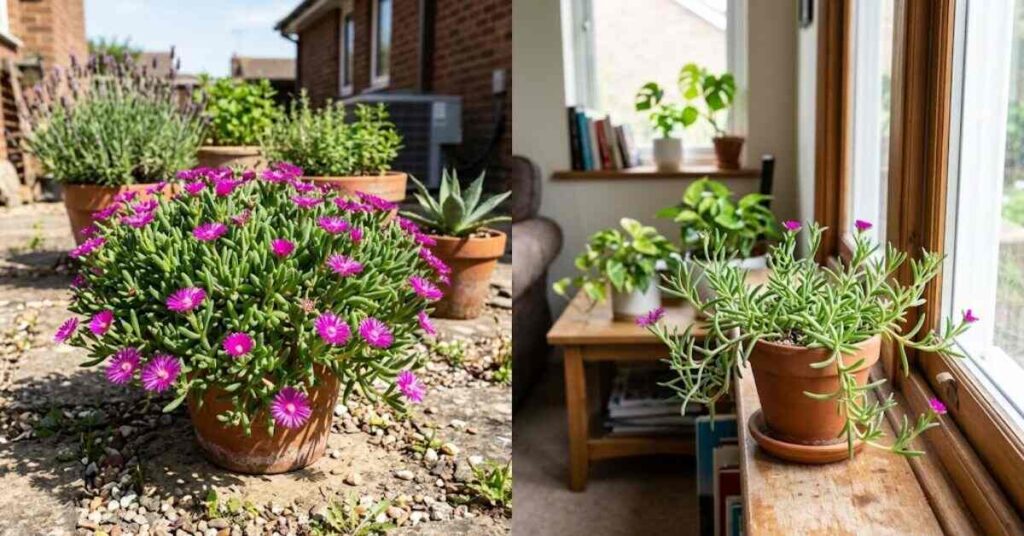
Hardy Delosperma is primarily an outdoor plant.
You can grow it in a container indoors temporarily, but ordinary indoor conditions often provide less direct sunlight than the plant wants.
A bright, sunny window may work for a container specimen, but watch for stretched growth.
If the plant begins leaning toward the glass and producing longer spaces between leaves, light intensity is probably inadequate.
For most gardeners, a sunny outdoor container is a much better use of an ice plant.
Quick Seasonal Care Calendar
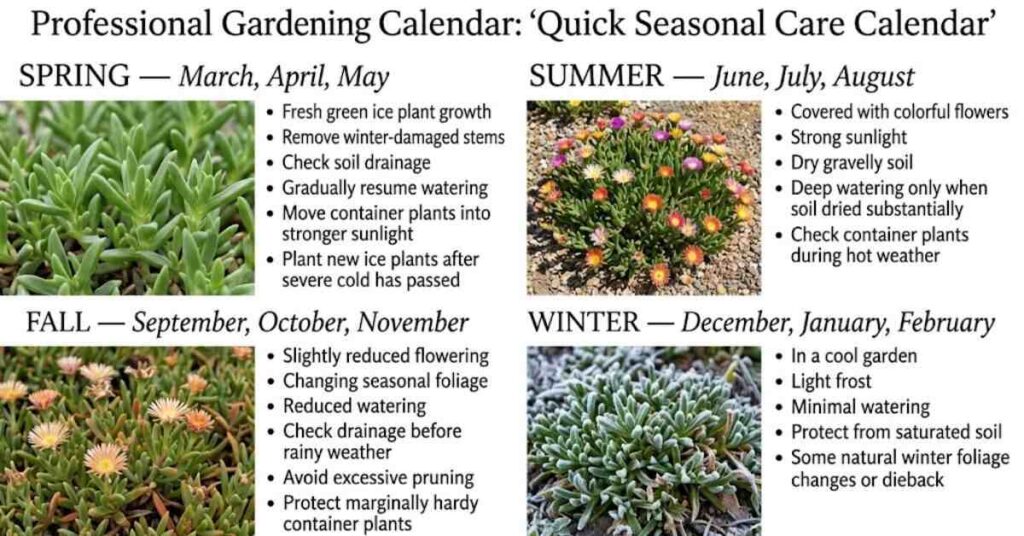
Spring
- Remove winter-damaged growth.
- Check that drainage hasn’t become compacted.
- Resume watering as active growth begins.
- Move containers into stronger light.
- Consider a light feeding only if the growing medium genuinely needs it.
- Plant new specimens after severe cold has passed in colder climates.
Summer
- Prioritize direct sun.
- Check container moisture more often than garden-bed moisture.
- Water deeply when the medium has dried substantially.
- Watch for rot after periods of heavy rainfall.
- Enjoy peak flowering from suitable cultivars.
Fall
- Reduce irrigation as temperatures and growth decline.
- Avoid excessive late-season pruning.
- Check drainage before the rainy season begins.
- Protect containers if the cultivar is marginally hardy.
Winter
- Keep vulnerable plants away from saturated soil.
- Don’t water automatically during cold, wet weather.
- Expect some cultivars to change foliage color or experience dieback.
- Protect marginal cultivars according to their specific hardiness rating.
FAQ — Ice Plant Care
Q1: How much sun does an ice plant need?
Ans: Hardy Delosperma generally performs best in full sun, with around 6 or more hours of direct light being a useful target. Less light can mean looser growth and fewer flowers.
Q:2 How often should I water ice plants?
Ans: There isn’t one reliable calendar interval for every climate. Water when the growing medium has dried substantially, then let excess moisture drain away rather than keeping the roots continuously wet.
Q:3 Can ice plants survive winter?
Ans: Some can, but hardiness varies dramatically by species and cultivar. Check the botanical name and cultivar rather than relying on the words “ice plant” alone.
Q4: Why is my ice plant turning yellow?
Ans: Excess moisture is one of the first things to investigate, especially if the soil remains wet. Poor drainage can damage roots and eventually cause yellowing, stem collapse, or plant death.
Q5: Can I grow an ice plant in a pot?
Ans: Yes. A container with a drainage hole and a gritty, fast-draining medium can be an excellent setup. Give it strong sunlight and avoid leaving water trapped in the saucer.
Q6: Does ice plant need fertilizer?
Ans: Usually very little. Healthy plants in reasonably suitable soil often perform without frequent feeding, and excessive fertility can encourage lush growth instead of the compact habit gardeners usually want.
Q7: Is ice plant safe for dogs and cats?
Ans: It depends on which plant is actually being sold as “ice plant.” ASPCA specifically lists Lampranthus piquet as non-toxic to dogs, cats, and horses, but that identification should not be generalized to every plant carrying the common name.
Q:8 Is ice plant invasive?
Ans: Some plants called ice plants can be invasive in particular regions. Carpobrotus edulis, for example, is notably different from ornamental hardy Delosperma, so identify the plant before planting it in an area where invasive species are regulated or problematic.
Final Verdict: Is Ice Plant Easy to Grow?
Yes if you give it the conditions it actually evolved to handle.
For hardy Delosperma, the winning combination is straightforward: strong sun, rapid drainage, restrained irrigation, and a cultivar suited to your winter climate.
The mistake is assuming that every plant sold as an “ice plant” follows the same rulebook. Check the botanical name first, especially if you are choosing a ground cover, planting near natural areas, or trying to predict winter survival.
Once you’ve got the identity right, an ice plant becomes one of the more rewarding options for a sunny rock garden, drought-tolerant border, container, or low-water landscape—delivering bright flowers without demanding the watering routine of a thirsty bedding plant.
Pingback: Pine Tree Guide: Care, Types, Identification & Uses
Pingback: Thrips on Plants: How to Identify & Control Them