
Rose leaves turning yellow usually means the plant is responding to stress, but yellowing alone doesn’t identify the cause. The most common reasons are inconsistent watering, poor drainage, nutrient deficiencies, insufficient light, heat stress, pests, and diseases such as black spot. The fastest way to fix the problem is to examine the pattern of yellowing, the age of affected leaves, soil moisture, and the undersides of the foliage before changing your care routine.
Important: I don’t have a physical garden or personal rose-growing history, so I won’t invent a first-person gardening anecdote. Instead, this guide uses a realistic diagnostic scenario based on horticultural and extension guidance: if a rose suddenly develops yellow leaves after several very hot days, first check soil moisture and drainage before reaching for fertilizer.
Quick-Reference Rose Care Specs
| Care factor | What roses generally need |
| Light | About 6–8 hours of direct sunlight for most garden roses |
| Water | Deep, consistent watering; adjust for soil, rainfall and heat |
| Soil | Fertile, moisture-retentive but well-drained soil |
| Temperature | Most roses tolerate a broad range, but extreme heat can cause stress |
| Humidity | Good airflow is more important than maintaining high humidity |
| Toxicity | Roses are not generally considered a major household poisoning concern, but thorns can injure people and pets |
| Difficulty | Beginner to intermediate |
Why Are My Rose Leaves Turning Yellow?
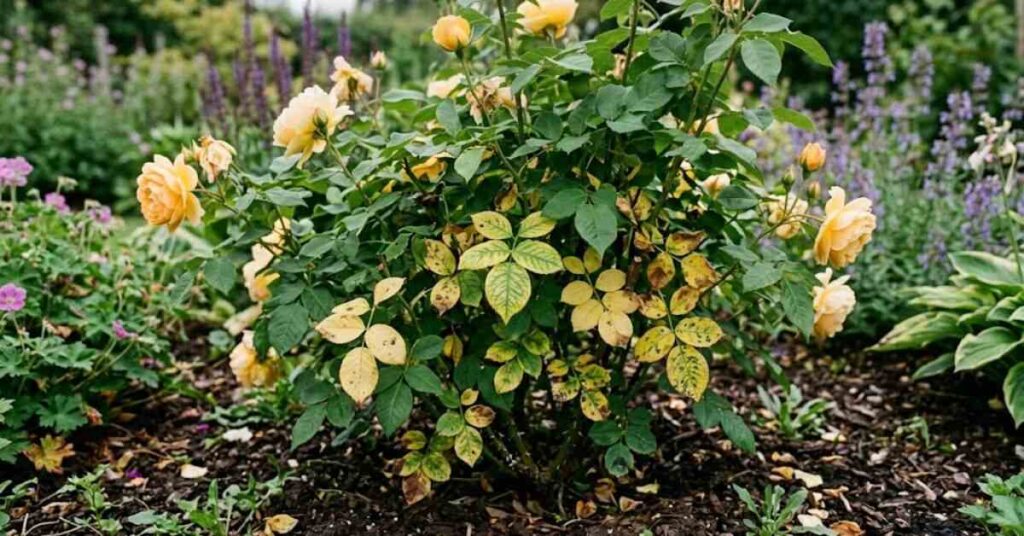
The important thing to remember is that yellow leaves are a symptom, not a diagnosis.
Before treating your rose, ask four questions:
- Are the old leaves or new leaves turning yellow first?
- Are the veins green while the tissue between them turns yellow?
- Is the soil dry, normally moist, or constantly wet?
- Do you see black spots, orange pustules, insects, stippling, or webbing?
Those observations can narrow the problem dramatically. The RHS notes that the position and pattern of chlorosis can provide important clues about its cause, while University of Maryland Extension uses specific leaf symptoms to distinguish nutrient, water and disease problems.
1. Could Underwatering Be Making Rose Leaves Turn Yellow?
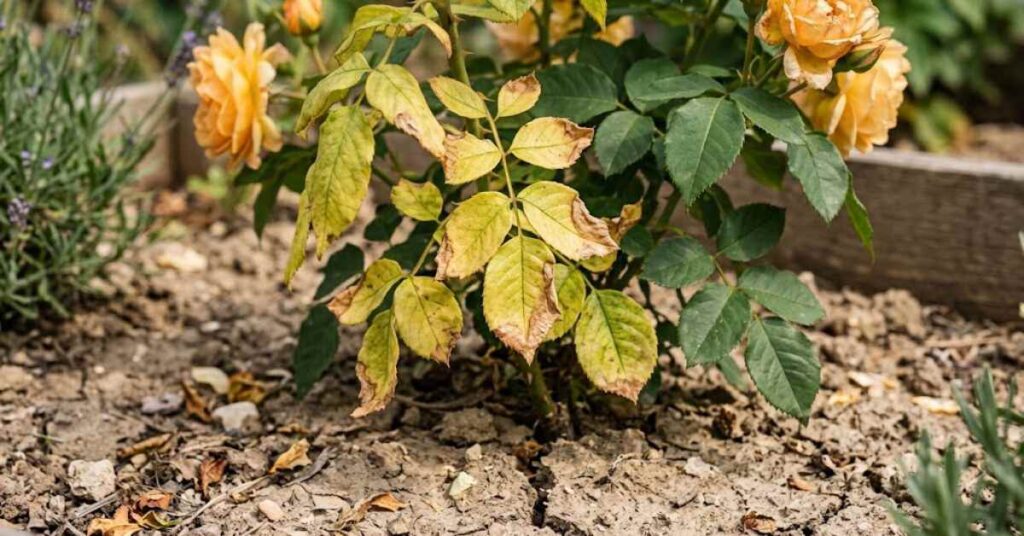
Yes. Underwatering is one of the most common causes of yellowing rose foliage, particularly during hot or windy weather.
A thirsty rose may show:
- Yellowing leaves
- Wilting
- Dry or crispy leaf edges
- Drooping flower buds
- Slower growth
- Potting mix that has dried out a few inches below the top layer.
Container-grown roses can be particularly vulnerable because their smaller soil volume dries faster. The Spruce recommends adjusting watering according to weather and soil type rather than relying on one rigid schedule.
How to fix underwatered roses
Don’t compensate with a tiny splash of water every day.
Instead:
- Check the soil several inches below the surface.
- If it is genuinely dry, water deeply at the base.
- Let excess water drain away.
- Add a layer of organic mulch around the root zone, keeping it away from direct contact with the crown.
- Check on your plants more frequently when conditions are hot, dry, or windy.
A rose growing in sandy soil may need more frequent watering than one growing in moisture-retentive loam.
2. Can Overwatering Cause Yellow Rose Leaves?
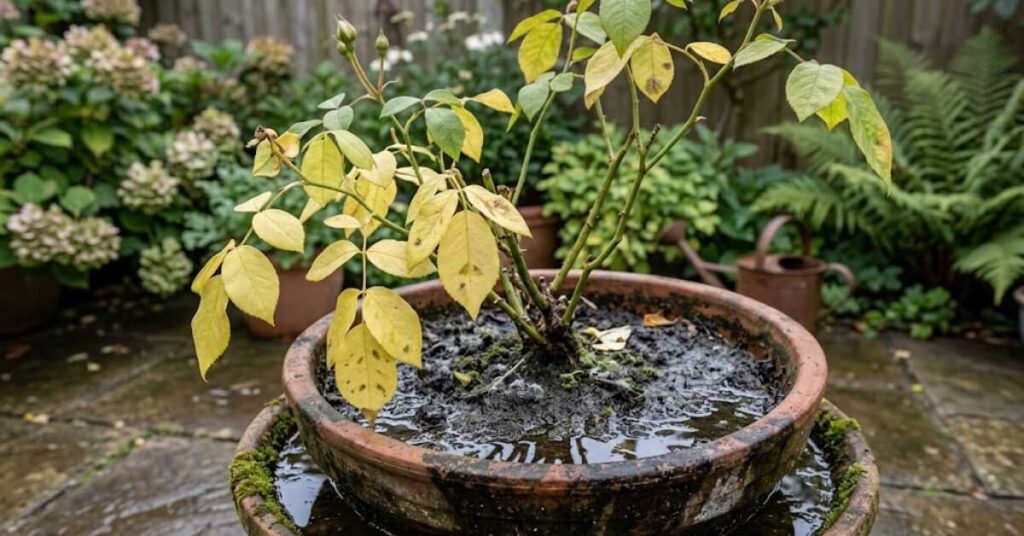
Absolutely and this is where many gardeners get fooled.
Overwatering can produce symptoms that resemble drought stress. The foliage may become yellow and limp even though the soil is wet.
The reason is simple: roots need oxygen as well as water. Persistently saturated soil reduces air-filled pore space around the roots and can contribute to root damage. RHS guidance identifies waterlogging and compacted soil as causes of chlorosis, while University of Maryland Extension links green-between-veins symptoms with excessive water and poor drainage.
Signs your rose may be overwatered
Look for:
- Wet soil that stays wet for days
- Yellow leaves combined with wilting
- Poor new growth
- A musty smell around saturated soil
- Poor drainage after rainfall
- Roots that are brown, soft or damaged when inspected
How to fix overwatered roses
Don’t immediately add fertilizer.
First:
- Stop unnecessary watering.
- Check drainage.
- Allow the root zone to dry appropriately between irrigation events.
- Improve compacted soil where practical.
- Make sure containers have unobstructed drainage holes.
- Avoid leaving container roses sitting in water.
The Spruce recommends allowing the top couple of inches of soil to dry between waterings for roses while adjusting for conditions.
3. Is a Nutrient Deficiency Causing Yellow Rose Leaves?
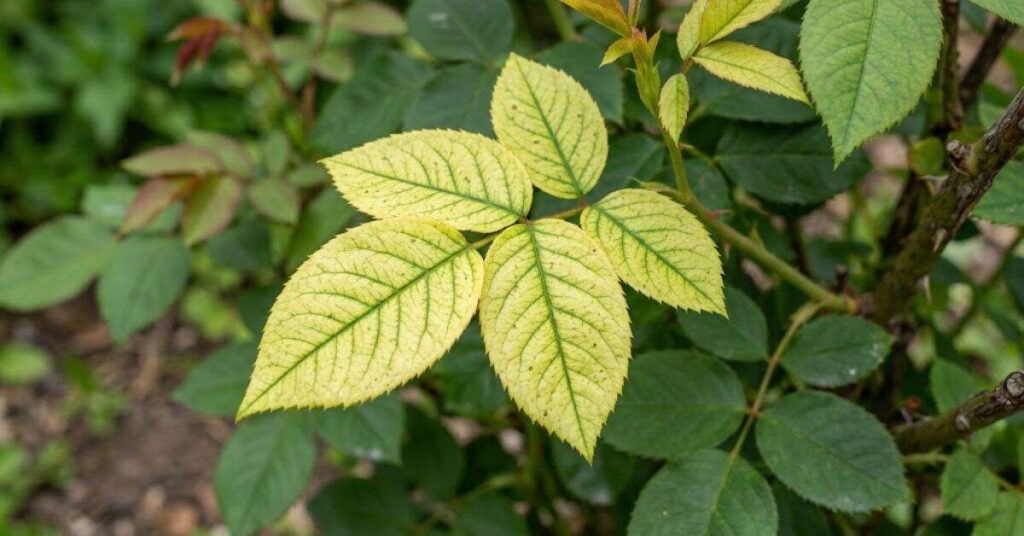
It can be, but don’t assume every yellow leaf means the plant needs fertilizer.
Several nutrient problems can produce chlorosis.
Nitrogen deficiency
Nitrogen deficiency commonly causes a more general yellowing that tends to begin with older leaves, often accompanied by reduced vigor. RHS guidance describes nitrogen deficiency as generalized yellowing or reddening, initially affecting older foliage.
Iron deficiency
Iron deficiency is different.
When young leaves develop yellow tissue while their veins remain noticeably green, iron availability becomes a strong possibility.
This is often associated with unsuitable soil pH rather than simply “not enough iron.” University of Maryland Extension specifically describes iron chlorosis as yellow leaves with prominent green veins and notes that high soil pH can contribute to the problem.
Magnesium deficiency
Magnesium deficiency can also cause interveinal yellowing, particularly on older leaves. RHS notes that magnesium and manganese deficiency generally begin on older leaves, whereas iron deficiency affects younger foliage first.
The important rule
Test before you treat.
Adding fertilizer without knowing what the soil lacks can create a second problem. Excess fertilizer can damage roots and foliage, and it won’t correct yellow leaves caused by root stress or fungal disease.
4. Is the Soil pH Causing Rose Leaf Chlorosis?
It can.
Soil pH affects how readily plants can access certain nutrients. If your rose has yellow leaves with strongly green veins, particularly on newer growth, testing the soil pH is more useful than automatically adding iron.
Many rose-growing references place roses in a slightly acidic to near-neutral soil range, commonly around pH 6 to 7, with exact preferences varying somewhat by soil and cultivar.
What to do
Use a reliable soil test rather than guessing.
If the test shows a significant pH problem, correct it according to the test recommendations. Avoid repeatedly adding lime, sulfur, iron or other amendments simply because a leaf looks yellow.
The goal is to correct the cause, not chase the symptom.
5. Could Black Spot Be Making Rose Leaves Yellow?
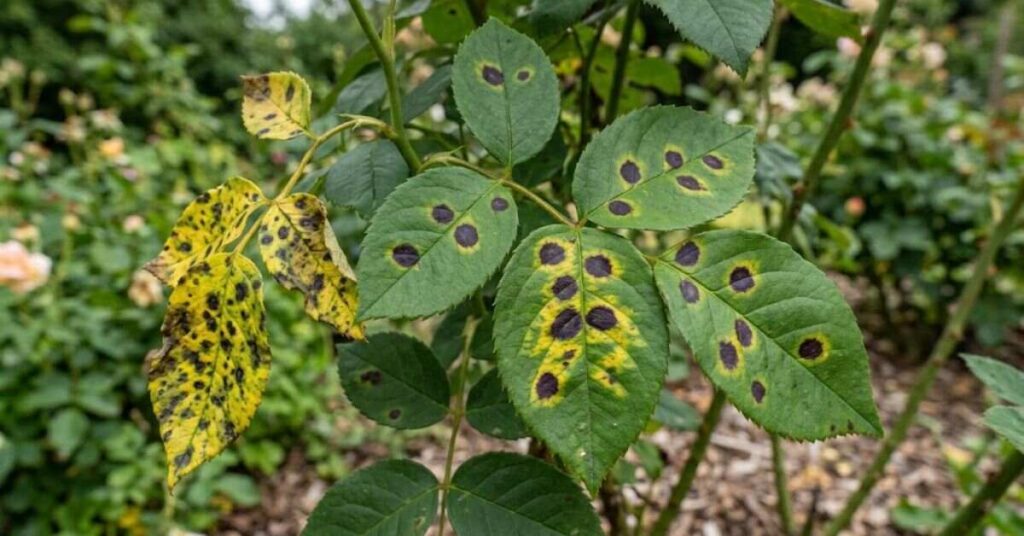
If yellowing occurs together with black or dark purple spots, black spots should be near the top of your diagnostic list.
The rose black spot is caused by the fungus Diplocarpon rosae. The RHS describes characteristic purple-to-black lesions followed by yellowing and premature leaf drop.
Typical black spot pattern
You may notice:
- Dark black or purple spots
- Yellow halos around spots
- Older lower leaves affected first
- Leaves dropping prematurely
- Progressive defoliation
- More severe symptoms during favorable wet conditions
Penn State Extension likewise identifies black spot as a disease that produces brown-to-black spots followed by yellowing and leaf drop.
How to manage black spot
Start with sanitation and cultural control:
- Remove heavily infected leaves.
- Clean up fallen diseased foliage.
- Improve airflow around the plant.
- Apply water directly to the soil instead of continually splashing the foliage.
- Avoid overcrowding.
- Prune appropriately to improve air movement.
The RHS recommends cultivation, sanitation, cultivar selection and natural disease-management practices as the first line of control.
If you use a fungicide, follow the product label and local regulations. The RHS specifically cautions that fungicides can have environmental consequences and recommends responsible, targeted use.
6. Could Spider Mites Cause Yellow Spots on Rose Leaves?
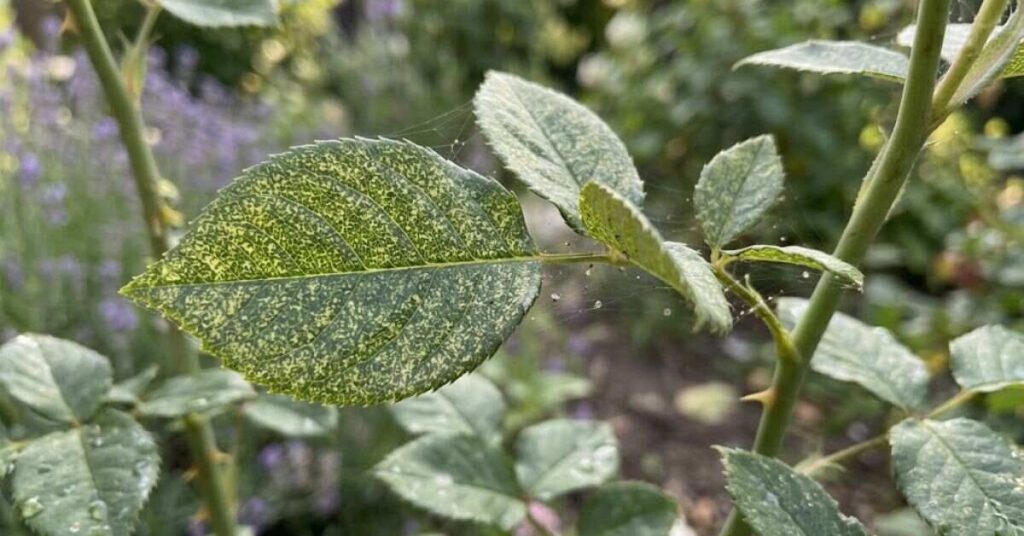
Yes.
Spider mites feed by sucking plant fluids from foliage. Instead of producing one large yellow patch, they often create tiny yellow speckles or stippling across the leaf.
Look underneath the leaves.
You may find:
- Fine webbing
- Tiny moving mites
- Pale stippling
- Leaves becoming increasingly bronze or yellow
The Spruce recommends checking leaf undersides and using a strong water spray to knock mites loose; severe infestations may require horticultural oil or another appropriately labeled treatment.
Avoid reaching immediately for broad-spectrum insecticides. They can kill beneficial organisms and sometimes make mite problems worse by disrupting natural predators.
7. Are Aphids or Other Rose Pests Responsible?
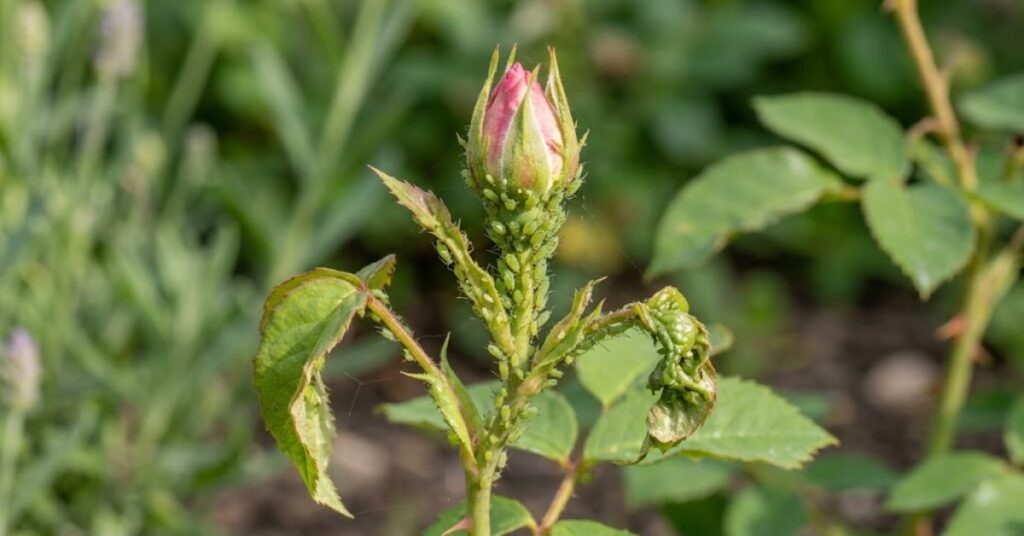
They can be.
Aphids commonly cluster around:
- Tender new growth
- Flower buds
- Young stems
- Leaf undersides
They may cause distorted or weakened growth rather than the classic uniform yellowing associated with some nutrient problems.
The RHS lists aphids among the most common rose problems and notes that heavy aphid feeding can be accompanied by sticky honeydew and sooty mould.
Inspect the plant carefully before deciding on treatment.
8. Can Too Much Sun or Extreme Heat Turn Rose Leaves Yellow?
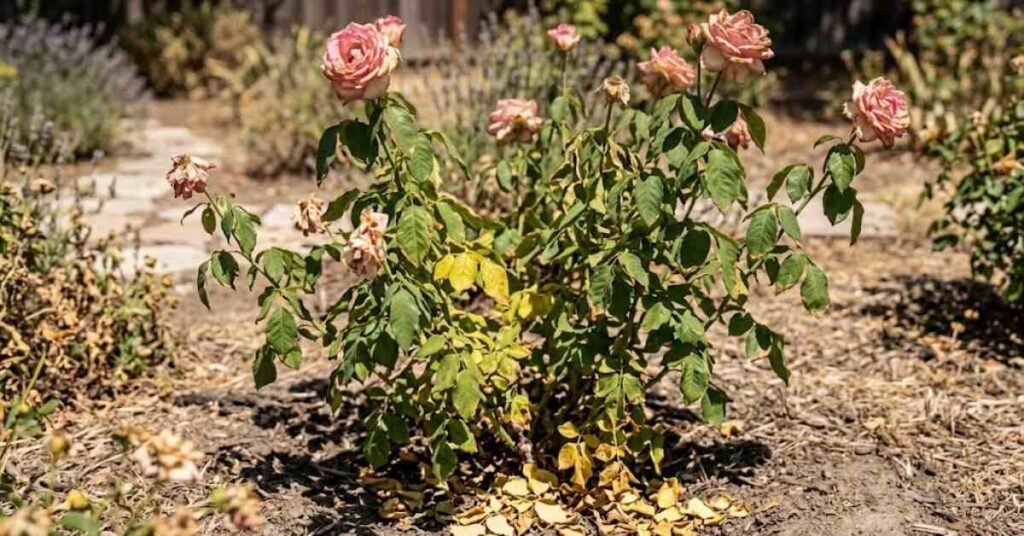
Yes but don’t confuse sunlight with heat stress.
Most roses perform best with abundant sunlight, commonly around 6–8 hours daily, but excessive heat can still stress foliage and flowers. The Spruce notes that heat stress may cause yellowing, wilting and scorched leaf edges.
During extreme heat:
- Water deeply when the soil actually needs it.
- Mulch the root zone.
- Avoid unnecessarily disturbing the roots.
- Protect container plants from extreme heat radiating from paving or walls.
- Keep enough airflow around the plant.
Don’t automatically move an established rose into heavy shade simply because its leaves yellowed during a heatwave. Determine whether the real problem is water loss, root stress, reflected heat or disease.
The PlantGuideCare Yellow-Leaf Diagnostic Matrix
This removes all guessing from the process.
| What you see | Most likely possibilities | First thing to check |
| Older leaves uniformly pale/yellow | Nitrogen deficiency, aging, general stress | Soil fertility + overall vigor |
| Young leaves yellow, veins stay green | Iron chlorosis / nutrient availability problem | Soil pH |
| Yellow leaves + black spots | Black spot | Leaf spots + sanitation |
| Yellow leaves + soil stays soggy | Overwatering / poor drainage | Drainage and root condition |
| Yellow leaves + dry soil + wilting | Underwatering | Root-zone moisture |
| Fine yellow speckles + webbing | Spider mites | Leaf undersides |
| Yellow spots + orange pustules underneath | Rose rust | Underside of leaves |
| Few shaded interior leaves yellow | Natural aging/shading | New growth and overall health |
| Yellowing after transplanting | Establishment stress | Root moisture + planting conditions |
| Yellowing with distorted/mosaic patterns | Disease, including possible virus | Extension diagnosis |
The disease distinctions are supported by RHS and university extension resources. For example, RHS identifies yellow spots accompanied by orange pustules underneath as rose rust, while Penn State lists mosaic and mottled patterns among symptoms associated with rose viruses.
Why this matrix matters
The biggest mistake gardeners make is treating the leaf color instead of diagnosing the plant.
If the soil is waterlogged, fertilizer isn’t the first answer.
If the leaf has black lesions, more water isn’t the answer.
If young leaves have green veins, adding random fertilizer without checking pH may miss the underlying problem.
If the leaf has fine stippling and webbing, the problem is probably not nitrogen deficiency.
Yellow is the starting clue not the diagnosis.
What Should You Do When Rose Leaves Start Turning Yellow?
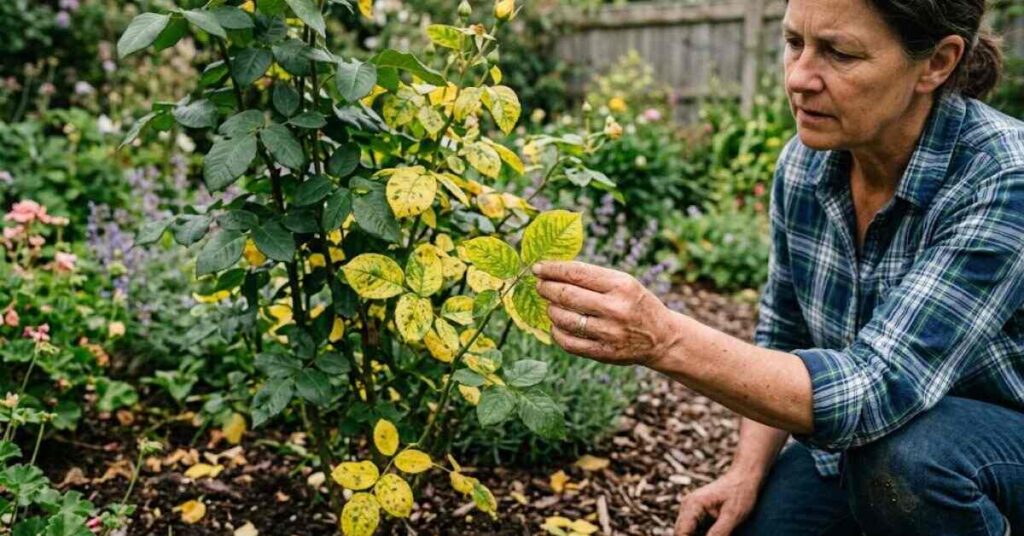
Use this five-step process.
Step 1: Check the soil
Push your finger several inches into the root zone.
- Dry: investigate underwatering.
- Moist: don’t automatically water.
- Soggy: investigate drainage and overwatering.
Step 2: Look at the affected leaves
Ask:
- Are old leaves affected?
- Are new leaves affected?
- Is the entire leaf yellow?
- Are the veins still green?
- Are there spots or lesions?
Step 3: Inspect the underside
Turn over several leaves.
Look for:
- Spider mites
- Webbing
- Aphids
- Orange rust pustules
- Eggs or other insects
Step 4: Check the environment
Look at:
- Hours of sunlight
- Recent heatwaves
- Rainfall
- Soil compaction
- Air circulation
- Nearby plants shading the rose
Step 5:Adjust only one major factor at a time
This is an underrated gardening rule.
If you simultaneously add fertilizer, increase watering, spray pesticide and change the soil, you won’t know what actually helped.
Make the most evidence-based correction first, then monitor the new growth.
Should You Remove Yellow Leaves From Roses?
Remove leaves when they are clearly diseased, heavily damaged, or unlikely to recover.
For black spots, removing infected foliage and fallen debris can help reduce disease pressure. RHS and university extension recommendations emphasize sanitation as part of black spot management.
However, don’t strip a rose bush simply because several leaves have turned yellow.
Leaves are still photosynthetic tissue until they senesce or become badly damaged. If the yellowing is caused by temporary environmental stress, removing every affected leaf can unnecessarily reduce the plant’s remaining foliage.
How Long Does It Take for Yellow Rose Leaves to Turn Green Again?
That depends on the cause.
A leaf that has already turned completely yellow may not return to its original green color.
Your better indicator is new growth.
For example:
- Correcting water stress should stop new damage once the root zone returns to a suitable moisture level.
- Correcting a nutrient or pH problem should eventually improve new foliage.
- Controlling pests should stop the spread of fresh damage.
- Disease management aims to protect healthy/new foliage rather than reverse every damaged leaf.
So don’t judge your treatment solely by whether yesterday’s yellow leaf turns green.
Watch what happens to the next leaves.
Common Troubleshooting Problems
My rose has yellow leaves but the soil is wet. What should I do?
Don’t water again just because the leaves look wilted. Check drainage, soil compaction and the root zone first. Overwatering can damage roots and produce yellowing that looks surprisingly similar to drought stress.
My rose leaves are yellow between green veins. What does that mean?
Interveinal chlorosis often points toward a nutrient-availability problem, particularly iron on younger foliage. Test the soil pH before adding amendments because high pH can reduce iron availability.
My rose leaves are yellow with black spots.
Black spots are a major possibility. Remove infected foliage and debris, improve airflow, and water at soil level; if symptoms are severe, consult an extension service or use an appropriately labeled treatment.
My rose leaves have tiny yellow dots and webs.
Inspect the undersides closely for spider mites. A strong water spray can help dislodge them, while persistent infestations may require a suitable horticultural oil or labeled miticide/insecticide.
Can too much fertilizer cause yellow leaves?
Yes. Excess fertilizer can damage roots and foliage, and repeatedly adding nutrients without a diagnosis can make the situation worse. Soil testing is preferable to guessing.
Do roses need full sun?
Most garden roses perform best with substantial direct sunlight, commonly around 6–8 hours per day. However, extreme heat can stress plants, so light requirements should be considered together with climate, water availability and cultivar.
Should I use Epsom salt for yellow rose leaves?
Don’t use Epsom salt simply because the leaves are yellow. Yellowing has many causes, and adding magnesium when magnesium isn’t deficient can create an unnecessary nutrient imbalance. Diagnose the problem first.
Are yellow leaves always a sign that my rose is dying?
No. Yellowing can result from temporary stress, natural aging, shading, watering problems, nutrient issues, pests or disease. The key is whether the yellowing is isolated or spreading and whether other symptoms spots, webbing, wilting, poor growth or dieback are present.
How to Prevent Rose Leaves From Turning Yellow
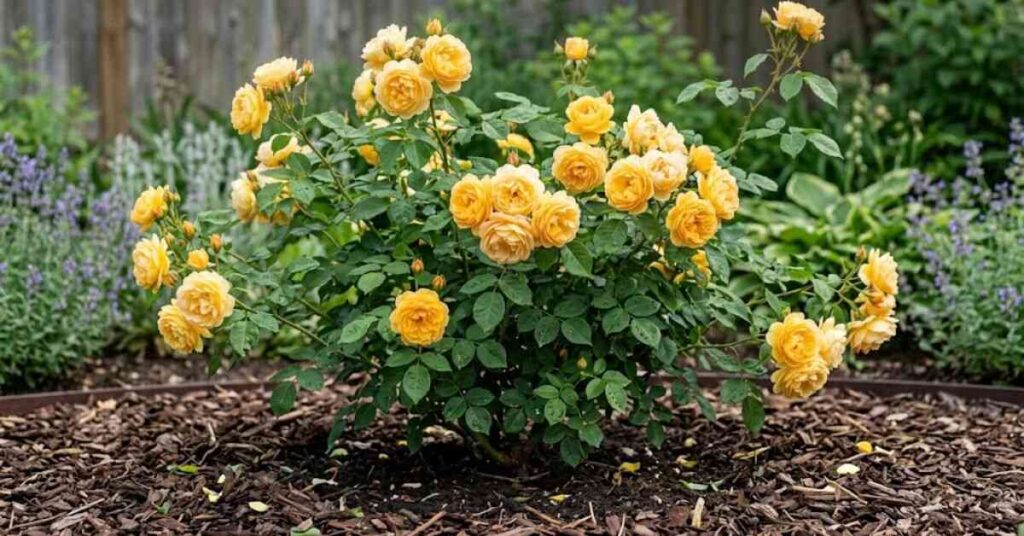
Healthy rose foliage starts with prevention rather than emergency treatment.
Give roses appropriate sunlight
Choose a location with enough direct light for the cultivar.
Water deeply and consistently
Avoid cycling between bone-dry soil and constantly saturated soil.
Improve drainage
Roses prefer moisture without prolonged waterlogging.
Keep foliage clean
Remove heavily diseased leaves and fallen debris when disease is present.
Encourage airflow
Avoid overcrowding and prune appropriately.
Monitor pests early
Inspect the underside of leaves before an infestation becomes severe.
Test soil before major amendments
A soil test is more useful than blindly adding fertilizer, lime, sulfur or micronutrients.
Mulch correctly
A suitable organic mulch can help moderate soil moisture and temperature. Keep the material clear of the plant’s central crown.
A Note on Climate: Why Yellowing Can Be Worse During Heatwaves
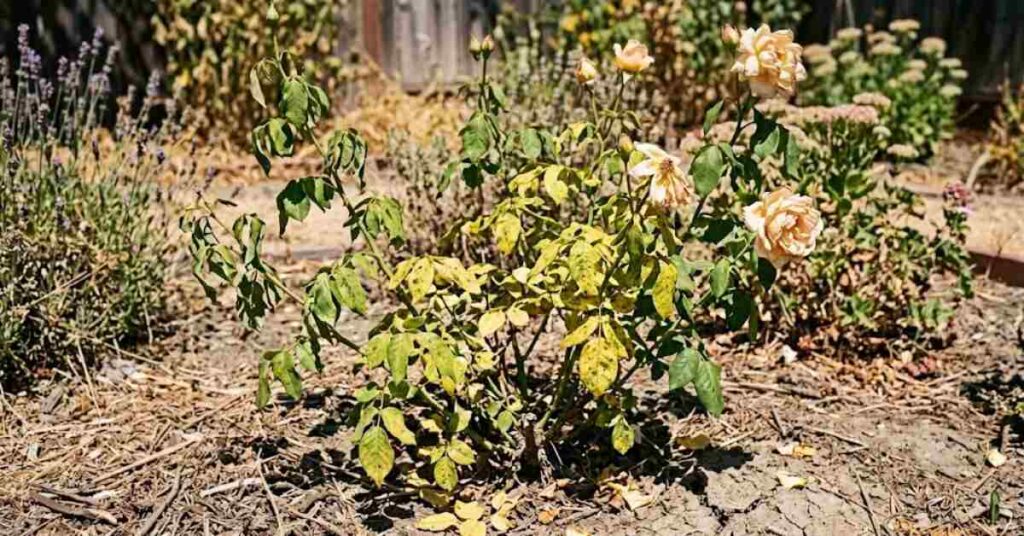
The same rose can behave differently under different weather conditions.
During a prolonged hot spell, soil moisture can disappear much faster than expected. Container roses can dry especially quickly, while heavy soils may remain wet underneath even when the surface looks dry.
That means a fixed watering calendar such as “water every Monday and Thursday”—is less reliable than checking the actual root-zone moisture.
Weather should change your monitoring frequency, not eliminate diagnosis.
This is particularly important in hot summer climates where high temperatures and evaporation can turn a previously adequate watering routine into drought stress within days.
When Should You Ask for Expert Help?
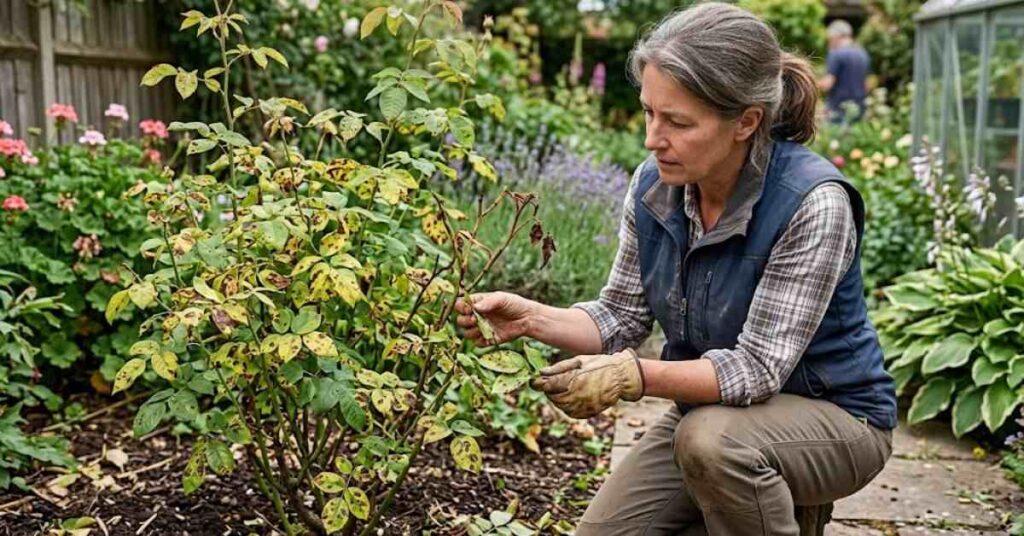
Consider contacting a local extension service, experienced rosarian, or plant diagnostic service if:
- The entire bush is rapidly defoliating.
- Yellowing is accompanied by severe dieback.
- You see unusual mosaics, rings or streaks.
- Multiple roses develop the same unexplained symptoms.
- Roots appear badly damaged.
- Disease continues despite sanitation and improved cultural care.
- You suspect a serious disease such as rose rosette.
University extension resources can be especially valuable because plant diseases and nutrient problems can vary by region. Penn State, for example, provides a detailed diagnostic table covering rose diseases including black spot, rust, viruses and other fungal diseases.
Frequently Asked Question
Q1: Why are my rose leaves turning yellow?
Ans: The most common causes are overwatering, underwatering, nutrient deficiencies, poor drainage, heat stress, pests, and diseases such as black spot. Check the soil moisture, leaf pattern, and underside of the leaves to identify the likely cause.
Q2: How do I fix yellow leaves on a rose bush?
Ans: First identify the cause rather than immediately adding fertilizer. Correct watering problems, improve drainage, check for pests or disease, and use a soil test if a nutrient deficiency is suspected.
Q3: Can overwatering cause rose leaves to turn yellow?
Ans: Yes. Constantly wet soil can stress or damage rose roots, causing yellow leaves and weak growth. Allow excess water to drain and avoid watering while the soil is already saturated.
Q4: Why are my rose leaves yellow with green veins?
Ans: Yellow tissue with green veins is known as interveinal chlorosis and can indicate an iron or other nutrient-availability problem. Check your soil pH before applying fertilizer or iron supplements.
Q5: Why are my rose leaves turning yellow with black spots?
Ans: This combination is commonly associated with black spot disease. Remove badly affected leaves and fallen debris, improve airflow around the rose, and avoid keeping the foliage wet for long periods.
Final Answer: Why Are Your Rose Leaves Turning Yellow?
If your rose leaves are turning yellow, don’t start by adding fertilizer.
Start with the four clues:
soil moisture → leaf age → yellowing pattern → additional symptoms.
Dry soil plus wilting points toward water stress. Soggy soil suggests drainage or overwatering. Yellow young leaves with green veins suggest chlorosis and possible nutrient-availability problems. Black spots point toward black spot disease, while fine stippling and webbing suggest spider mites.
Once you identify the pattern, correct the underlying cause rather than treating the yellow color itself. In many cases, the most meaningful sign of recovery isn’t an old leaf turning green again—it’s healthy new foliage appearing without the same symptoms.
Credible references including the RHS, University of Maryland Extension, Penn State Extension, and the American Rose Society all support diagnosing yellowing through accompanying symptoms rather than assuming a single universal cause.