
Goldfish plant care is mainly about getting four things right: bright filtered light, a breathable potting mix, controlled watering, and warm growing conditions. Meeting these basic care needs allows Nematanthus gregarius to yield glossy trailing stems and its signature orange, fish-shaped indoor blooms.
The biggest beginner mistake is following a fixed watering calendar. Factors like pot type, soil mix, temperature, airflow, and light dictate how often your plant needs water making condition-based care far more effective than sticking to a fixed seven-day schedule.
Before You Start: Make Sure You Have the Right Goldfish Plant
The common name can be confusing.
The plant most often discussed in modern care guides as Nematanthus gregarius belongs to the Gesneriaceae family and is native to southeast Brazil. NC State describes it as an evergreen tropical epiphyte with fleshy leaves and small orange, pouch-like flowers.
However, Columnea species are also widely sold as goldfish plants. Petal Republic, for example, specifically discusses Columnea gloriosa, while Gardening Know How uses Columnea gloriosa for its goldfish plant guide.
That distinction matters when you are comparing care instructions online.
If your plant label says Nematanthus gregarius, this guide is written specifically with that plant in mind.
Quick Goldfish Plant Care Guide
| Care factor | Beginner-friendly target |
| Light | Bright filtered or indirect light |
| Water | Water thoroughly after the growing medium has partly dried |
| Soil | Loose, airy, well-draining mix |
| Temperature | Warm indoor conditions; protect from cold |
| Humidity | Moderate humidity is helpful; avoid stagnant air |
| Fertilizer | Diluted balanced houseplant fertilizer during active growth |
| Pot | Drainage holes are essential |
| Pruning | Trim long or sparse stems to encourage branching |
| Propagation | Stem cuttings |
| Flowering | Strong light and healthy growth are key |
| Pet safety | ASPCA lists the gold-fish plant under Hypocyrta nummularia as non-toxic to cats and dogs |
| Difficulty | Beginner to intermediate |
According to the NC State Extension, N. gregarius excels as a container and hanging-basket plant when grown in light shade and well-draining soil.
What Does a Healthy Goldfish Plant Look Like?
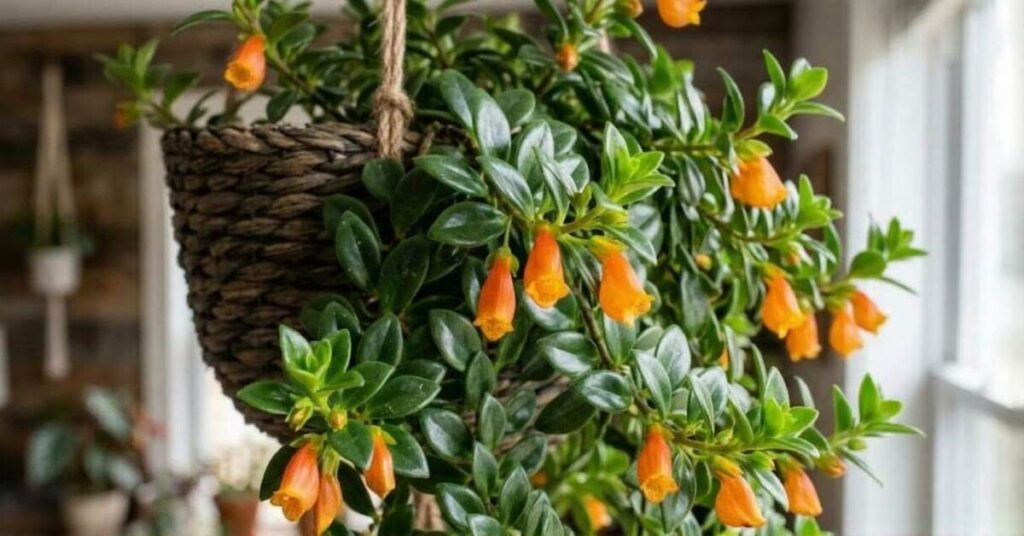
Before changing anything, learn what “normal” looks like.
A healthy plant should have firm, glossy foliage, flexible trailing stems and active growth at the tips. The leaves should not look permanently limp, mushy or dull.
The stems naturally cascade, which makes the plant particularly attractive on a shelf or in a hanging container.
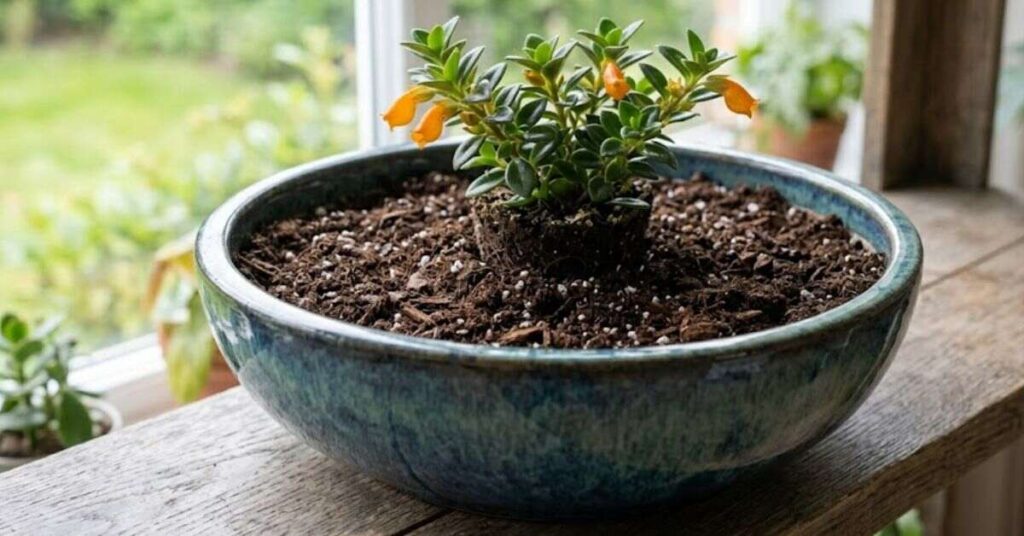
The flowers are the real showpiece. They are tubular and swollen, with a shape that gives the plant its fish-related common name. NC State records the flowers as orange and generally appearing in summer.
If your plant has healthy green leaves but isn’t flowering, don’t immediately assume it is sick. Flower production is more demanding than simply keeping foliage alive.
Where Should You Put a Goldfish Plant?
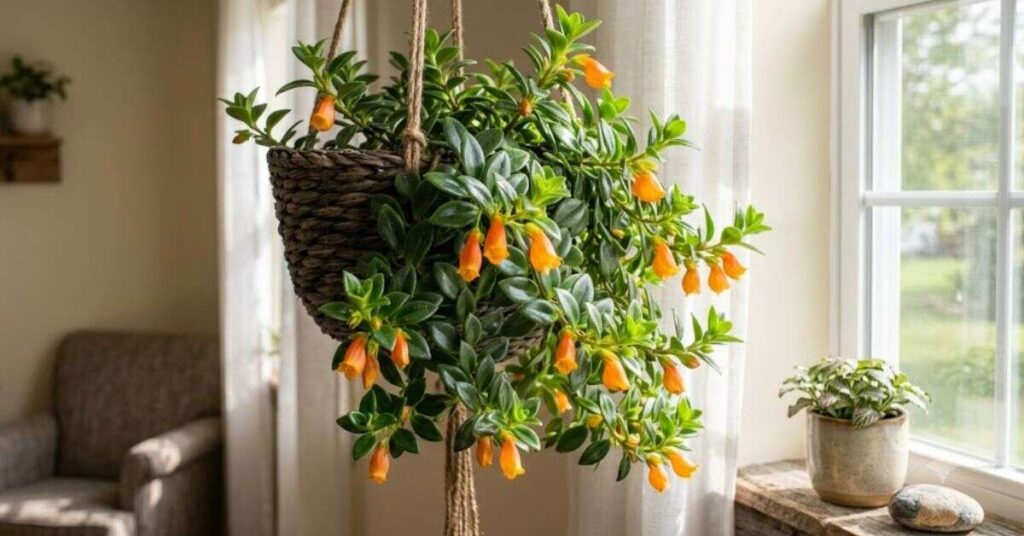
Choose a location where the plant receives strong, filtered light without spending hours in harsh direct afternoon sun.
An east-facing window is a useful starting point. A brighter south or west exposure can also work if the strongest rays are filtered.
The important distinction is this:
Bright does not mean baking.
A plant can easily get plenty of light for healthy growth without being pressed against hot window glass.
How to tell if the location is too dark
Look at the newest stems.
If new growth develops with noticeably long spaces between leaves, the plant is probably stretching toward available light. A flowerless plant with increasingly sparse stems is another reason to investigate lighting.
How to tell if the light is too intense
Watch for:
- Bleached-looking patches
- Crispy brown areas
- Scorched foliage on the window-facing side
If that happens, move the plant back from the glass or filter the strongest sunlight.
NC State recommends bright filtered light indoors and warns that the plant should not receive extended full sun through a south-facing window.
How Much Water Does a Goldfish Plant Need?
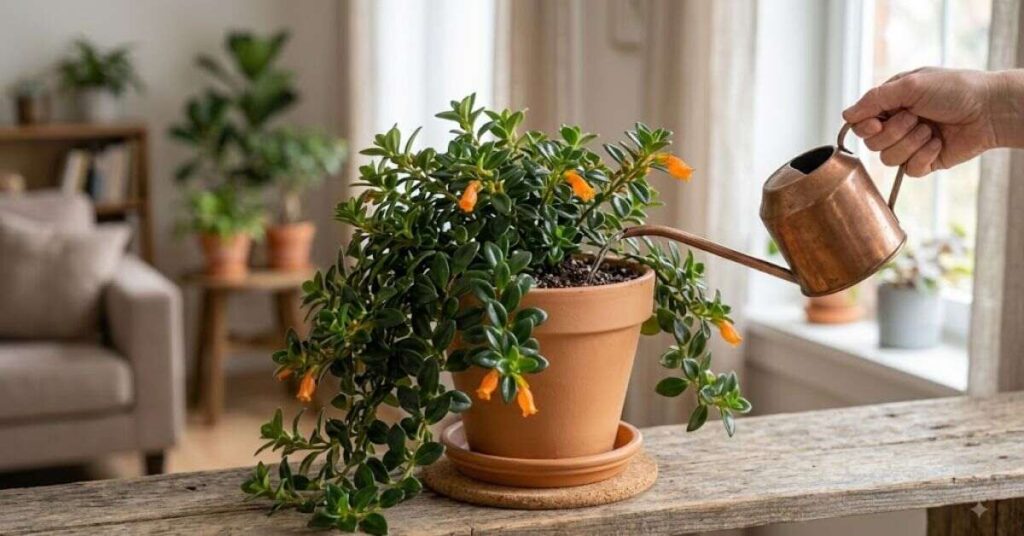
Base your care decisions on soil moisture levels, not the day of the week.
Water when the growing medium has dried enough that the roots have had a chance to breathe, then give the plant a thorough drink and allow the excess to leave the pot.
The exact interval can change dramatically.
A small plant in a warm room may dry much faster than a large plant sitting in a cool corner. A plastic pot also holds moisture differently from a porous clay container.
A simple beginner test
Before watering, check three things:
1. Feel the growing medium.
Don’t judge it from the surface alone.
2. Lift the container.
A recently watered pot feels substantially heavier than one that has dried.
3. Inspect the leaves.
Look for the overall pattern rather than reacting to one slightly imperfect leaf.
If the soil is still noticeably damp and the plant is showing yellowing or leaf loss, adding more water is unlikely to solve the problem.
NC State recommends moist, well-drained conditions, while several current care guides also emphasize allowing some drying between waterings.
What Is the Best Soil Mix for a Goldfish Plant?
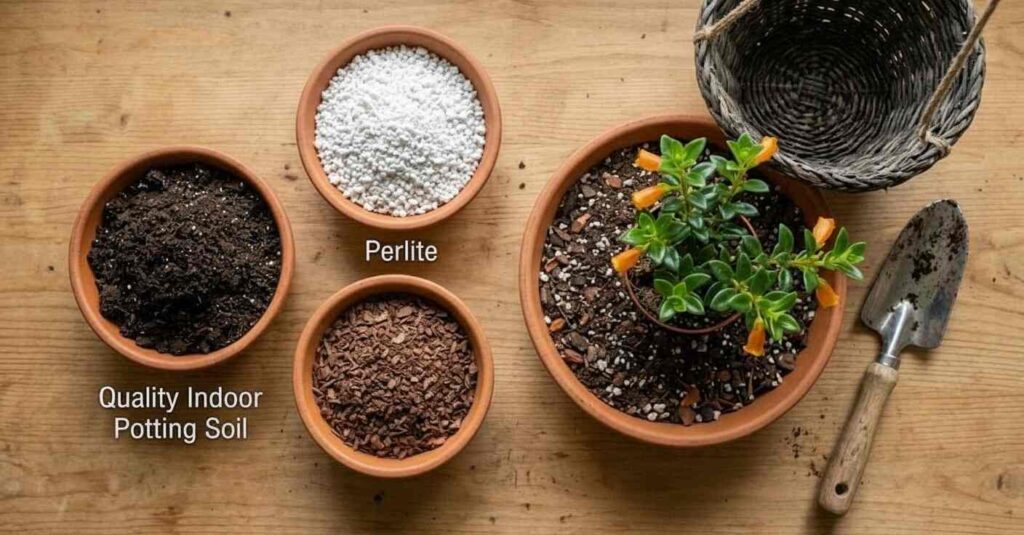
Plant roots require a balance of both water and oxygen to stay healthy.
A useful homemade starting point is:
- 2 parts quality indoor potting mix
- 1 part perlite
- 1 part fine orchid bark
This is not a sacred recipe. The goal is to create a medium that absorbs water without becoming a heavy, airless mass.
Because Nematanthus gregarius is an epiphyte, its natural growth habit is very different from that of a plant adapted to compact garden soil.
How can you tell the mix is too dense?
If the pot stays heavy and saturated for a prolonged period after watering, check the quality of your potting soil.
A dense mix can create a frustrating cycle:
Wet roots lead to weak growth and yellow leaves. Seeing a plant look unhappy often prompts more watering, which only leaves the roots wetter than before.
Don’t solve a root-zone problem by simply increasing the amount of water or fertilizer.
Does a Goldfish Plant Need High Humidity?
It appreciates a reasonably humid environment, but you don’t need to turn your home into a greenhouse.
The more important goal is to avoid extremely dry air combined with hot airflow.
Using a compact humidifier is a practical way to raise moisture levels in a dry room.. Grouping plants can also slightly increase moisture around their foliage.
Avoid placing the goldfish plant directly beside:
- A heating vent
- An air-conditioner outlet
- A fan blowing continuously across the foliage
- A drafty exterior door
Humidity and ventilation should work together. Extremely humid, stagnant air can create a different set of problems.
What Temperature Is Best for a Goldfish Plant?
Warm indoor temperatures suit this tropical plant.
NC State notes that Nematanthus gregarius cannot tolerate temperatures below approximately 50°F (10°C).
That makes it much better suited to a protected indoor environment than an exposed outdoor location in a cool climate.
If you move it outdoors during warm weather, transition it gradually rather than placing it immediately in strong midday sunlight.
How Should You Fertilize a Goldfish Plant?
Fertilizer supports growth; it does not replace light.
During active growth, use a diluted balanced liquid houseplant fertilizer according to the product label.
A beginner-friendly approach is to feed conservatively rather than repeatedly applying concentrated fertilizer.
If the plant has:
- Good green foliage
- Strong new growth
- Adequate light
- Healthy roots
Then regular nutrition can support continued growth and flowering.
Fertilizer cannot compensate for a lack of proper lighting.
How Do You Get a Goldfish Plant to Flower?
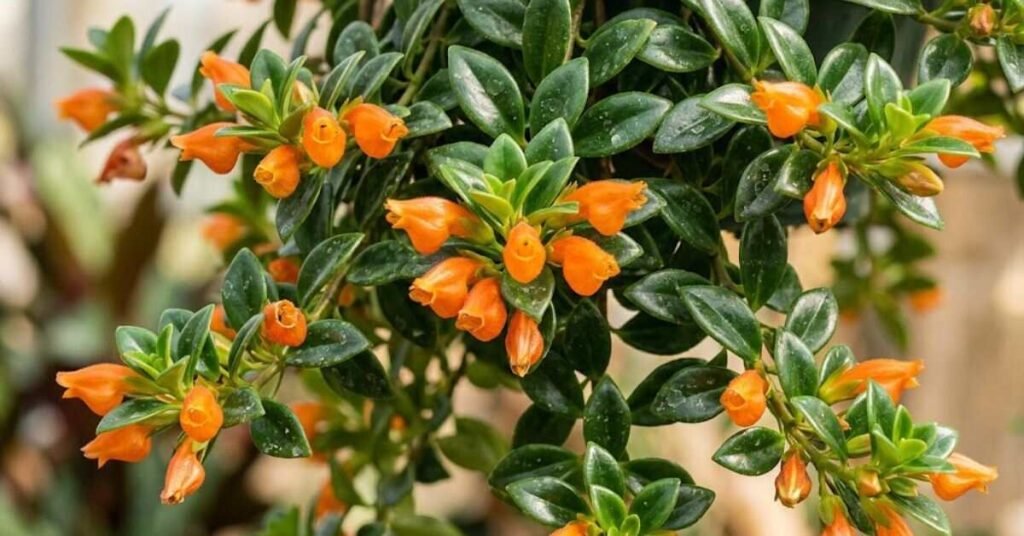
Flowering begins with enough usable light.
If your plant is growing long green stems but producing few flowers, examine the light before changing everything else.
Then check:
Light
Give the plant a brighter position with filtered light.
Root health
A plant with stressed or chronically wet roots is unlikely to produce its best flowering.
Water consistency
Avoid repeatedly allowing the plant to become severely dry and then soaking it heavily.
Nutrition
Feed moderately during active growth rather than relying on a high-strength fertilizer.
Pruning
Removing excessively long growth can encourage a fuller plant with more potential flowering points.
BHG likewise identifies bright indirect light, appropriate moisture and feeding as important components of flowering, while its guide notes that insufficient light is a common reason for poor blooming.
Why Is My Goldfish Plant Not Flowering?
Use this diagnostic order:
Is it bright enough?
If not, fix the light.
Is it actively growing?
If the plant is barely producing new growth, solve the environmental problem first.
Is the root zone healthy?
If the soil stays wet for long periods, investigate drainage.
Has the plant recently moved?
A change in light or temperature can disrupt growth.
Are you pruning too aggressively?
Give newly trimmed stems time to develop.
The mistake is trying to solve a light problem with fertilizer.
When Does a Goldfish Plant Bloom?
N. gregarius is recorded by NC State as a summer-flowering plant, although indoor plants may behave differently depending on their growing conditions.
Your plant may not follow a perfect seasonal timetable indoors.
Instead of worrying about an exact flowering date, watch for the conditions that precede flowering:
strong light + active growth + healthy roots + stable warmth.
How Do You Prune a Goldfish Plant?
Pruning is useful when the plant has become thin, overly long or uneven.
Use clean scissors or pruning shears and cut healthy stems just above a node.
You can remove:
- Dead growth
- Damaged sections
- Bare sections that no longer contribute to the shape
- Excessively long stems
- Weak growth
Don’t remove large portions of the plant simply because it looks untidy.
A better strategy is to gradually shorten the longest stems and allow fresh side growth to develop.
Bonus: save the healthy pieces
Those cuttings can become new plants.
This makes pruning especially useful for an older goldfish plant: you’re simultaneously reshaping the mother plant and creating propagation material.
How Do You Propagate a Goldfish Plant?
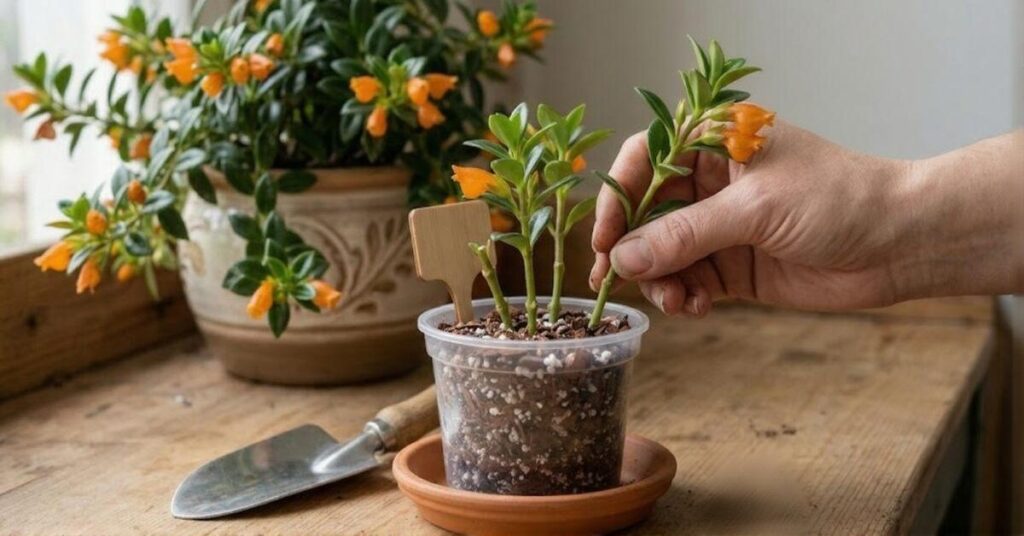
Stem cuttings are the practical choice for beginners.
Soil propagation
- Choose a healthy non-damaged stem.
- Take a cutting that contains a usable node.
- Remove leaves that would sit underneath the propagation medium.
- Place the cutting into a lightly moist, airy mix.
- Keep it warm.
- Give it bright filtered light.
- Maintain gentle moisture while roots develop.
Water propagation
You can also place a suitable cutting in clean water and wait for roots to form.
The advantage is visibility—you can actually watch the roots develop.
The disadvantage is that water-grown roots later need to adjust to a solid growing medium.
For a beginner growing only a few cuttings, either method is reasonable.
For producing several plants at once, direct soil propagation is often simpler because there is no second rooting environment to manage.
When Should You Repot a Goldfish Plant?
Repotting should respond to the condition of the plant rather than an arbitrary annual deadline.
Look for:
- Roots filling the container
- Roots emerging from drainage holes
- A degraded or compacted potting mix
- Water behaving unusually because the root mass has become dense
- Growth becoming restricted despite otherwise good conditions
When repotting, move into a container only modestly larger than the current one.
A huge decorative pot may look attractive, but it also introduces a large amount of unused soil that can remain wet around a relatively small root system.
The Goldfish Plant Diagnostic Method: Symptom → Test → Action
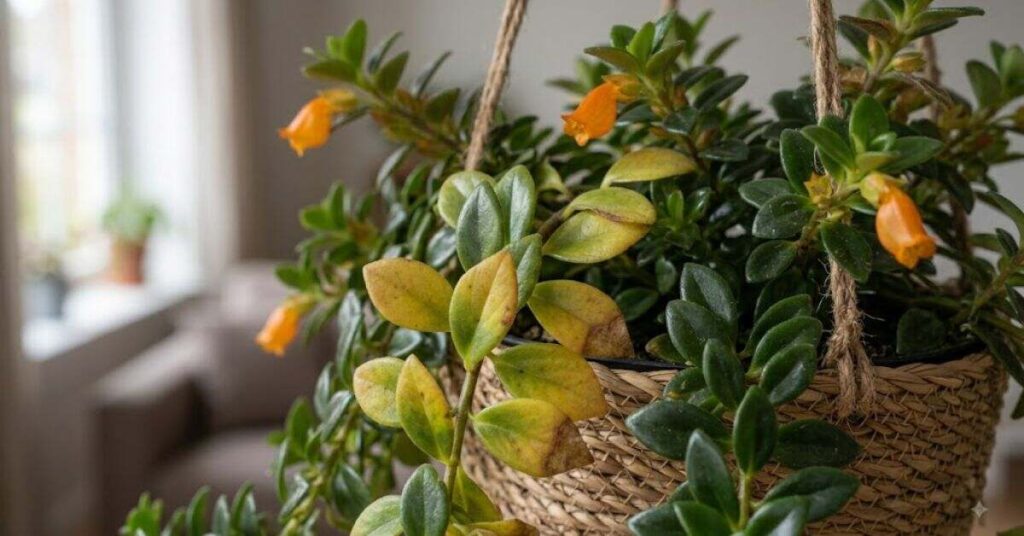
If you are new to plant care, this is the most important part to save.
Instead of changing three care habits at once, diagnose the plant in sequence.
Symptom: Yellow leaves
Test
Check the soil first.
If the soil stays wet
Investigate watering frequency, drainage and soil structure.
If the soil is extremely dry
Review your watering interval and pot size.
If only an occasional old leaf is yellow
Look at the newer growth before assuming the whole plant has a problem.
Symptom: Leaves suddenly falling
Test
Take a second to recall what might have shifted in the last few days.
Ask:
- Was the plant moved?
- Did the temperature drop?
- Did watering change?
- Is the soil staying wet?
- Did it move closer to a heating or cooling vent?
Sudden leaf drop after a major environmental change deserves a different response from gradual leaf loss caused by chronically poor conditions.
Symptom: Long, thin stems
Test
Examine the light.
If the plant is far from a bright window, low light is an obvious suspect.
Action
Move it toward stronger filtered light gradually.
Don’t compensate for low light by feeding heavily.
Symptom: Soft stems
Test
Check the root-zone moisture.
If the potting mix is wet and the stems are becoming soft, investigate overwatering and drainage.
Adding more humidity won’t solve the issue here.
Symptom: Brown leaf edges
Test
Look at the environment.
Possible factors include:
- Very dry air
- Excessive direct sun
- Fertilizer or mineral accumulation
- Inconsistent watering
Evaluate the full plant before selecting a treatment.
What Are Common Goldfish Plant Pests?
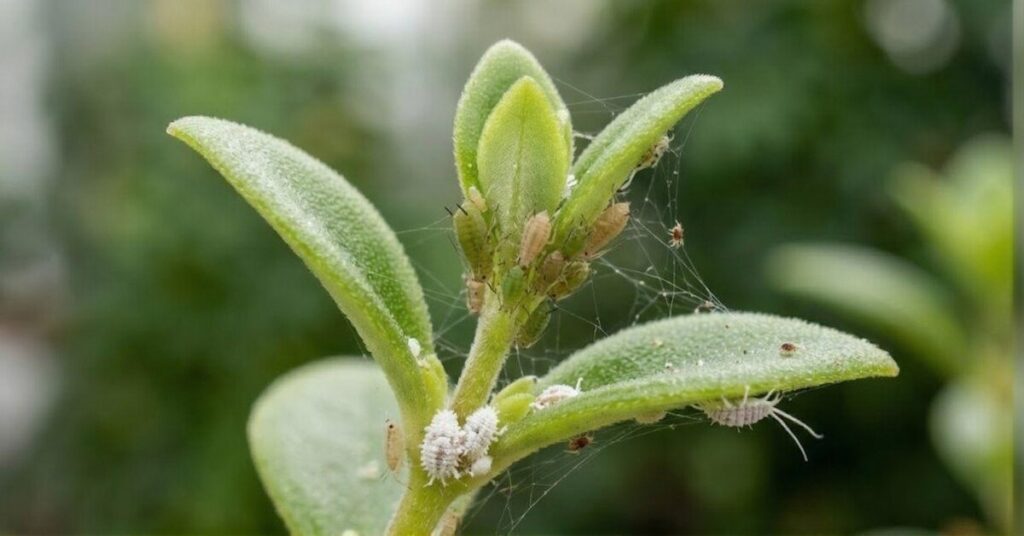
Regular inspection is more effective than waiting until an infestation becomes obvious.
Mealybugs
Look for small cotton-like clusters around stems, nodes and leaf joints.
Spider mites
Watch for fine webbing, tiny speckles and a generally dusty or faded appearance.
Aphids
These may cluster around tender new growth.
NC State lists aphids among the known pest concerns for N. gregarius.
If you find pests, isolate the plant when possible and treat according to the label of an appropriate houseplant pest-control product. Recheck the plant repeatedly rather than assuming one treatment has solved the entire infestation.
Is a Goldfish Plant Toxic to Cats?
The ASPCA lists Gold-Fish Plant / Candy Corn Plant under the scientific name Hypocyrta nummularia on its non-toxic plant lists for cats and dogs.
That provides useful reassurance for pet owners.
There is one important caveat: “goldfish plant” is a common name used for multiple plants. If your plant’s botanical name is unknown, identify the plant before assuming that every plant sold under this name has exactly the same safety profile.
Even plants classified as non-toxic should not become a regular part of a pet’s diet.
Goldfish Plant Care Mistakes Beginners Should Avoid
Mistake 1: Watering by weekday
The plant responds to its growing environment, not your calendar.
Mistake 2: Putting it in a dark corner
A plant can survive in lower light for a while without thriving there.
Mistake 3: Using heavy garden soil
Container roots need an airy environment.
Mistake 4: Buying an oversized decorative pot
Extra soil means extra moisture around the roots.
Mistake 5: Adding fertilizer whenever the plant looks unhappy
Fertilizer cannot repair damaged roots, inadequate light or cold stress.
Mistake 6: Treating every yellow leaf as a nutrient deficiency
Yellowing is a symptom, not a diagnosis.
Mistake 7: Moving the plant directly into harsh outdoor sunlight
A sheltered indoor plant needs time to acclimate.
Goldfish Plant FAQS
Q: Is a goldfish plant easy to care for?
A: Yes, once its light and watering pattern are understood. Beginners usually have the most trouble when the plant receives too little light or stays wet for too long.
Q: Can goldfish plants grow indoors?
A: Absolutely. Nematanthus gregarius is commonly grown as an indoor container or hanging-basket plant outside its tropical native environment.
Q: How often should I water a goldfish plant?
A: Don’t use a universal weekly schedule. Check the growing medium and water when it has partially dried, then allow excess water to drain away.
Q: Why does my goldfish plant have leaves but no flowers?
A: Insufficient light is one of the first things to investigate. If the plant has healthy foliage but poor flowering, move it to a brighter filtered position before dramatically changing fertilizer.
Q: Can I grow a goldfish plant from a cutting?
A: Yes. Stem cuttings are a practical propagation method, and you can root them either in a suitable propagation medium or in water.
Q: Can goldfish plants live in a bathroom?
A: A well-lit bathroom makes a great spot for this plant, provided it gets sufficient natural sunlight or grows light support. High humidity alone will not compensate for a dark room.
Q: Should I mist my goldfish plant?
A: Misting is not essential. If your indoor air is genuinely dry, maintaining more consistent ambient humidity is generally more useful than repeatedly spraying the leaves.
Q: Why are my goldfish plant leaves turning yellow?
A: Start with the root zone. Persistent wetness, poor drainage, watering stress and environmental problems can all produce yellow foliage, so don’t automatically reach for fertilizer.
Final Goldfish Plant Care Checklist
If you’re caring for Nematanthus gregarius for the first time, keep the routine simple:
Give it bright filtered light.
Use a loose, well-draining growing medium.
Water thoroughly, then let the medium partially dry.
Keep the plant in a warm area and protected from cold air currents.
Provide reasonable humidity without creating stagnant conditions.
Feed lightly during active growth.
Prune long stems to encourage a fuller shape.
Root healthy cuttings to grow new plants rather than discarding them.
Diagnose yellow leaves and leaf drop before changing the entire care routine.
Most importantly, don’t try to make your plant follow someone else’s watering calendar. Learn how quickly your pot dries, how much light your room provides, and how the plant responds to those conditions.
That’s the difference between simply keeping a goldfish plant alive and actually growing one that looks full, vigorous and capable of flowering.