
Thrips on plants are tiny pests that can turn healthy-looking foliage into a patchwork of silver, brown and distorted tissue. The quickest way to recognize an active infestation is to look for the combination of silvery feeding damage, tiny black fecal spots and slender insects hiding around new growth, flowers or leaf folds.
The good news is that thrips can be brought under control. The key is not relying on one spray; instead, combine inspection, physical removal, monitoring and a treatment appropriate for the pest’s location and life stage.
A Practical Starting Point
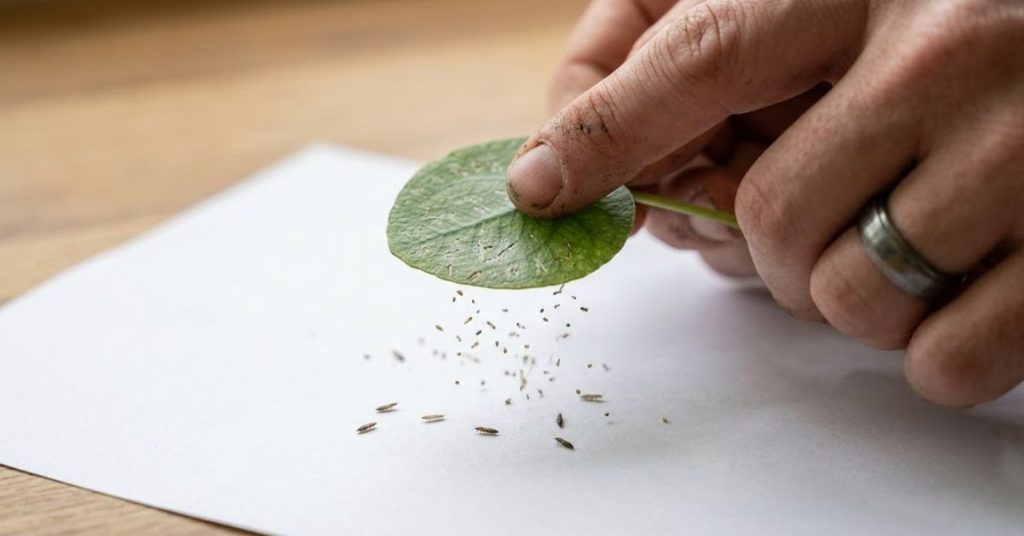
A common mistake is to search the entire plant for an obvious swarm of insects. Thrips don’t make that easy. Their bodies can be around 1–2 mm long, and many spend much of their time tucked into flowers, young leaves or other protected spaces.
For a useful inspection, place a sheet of white paper beneath a suspicious leaf or flower and gently tap the plant. Look for tiny moving slivers rather than expecting a large cluster of insects.
If the plant is indoors, move it away from neighboring plants as soon as you have reasonable evidence of thrips. This simple step can prevent a localized pest problem from becoming a collection-wide problem.
Quick-Reference Thrips Control Guide
| Situation | Best first move | Why |
| A few visible insects | Rinse or wipe the plant | Removes exposed adults and larvae |
| Silvering but no visible insects | Inspect buds and new growth carefully | Thrips often hide where damage begins |
| Several adult insects flying | Add sticky cards | Helps monitor flying adults |
| Damaged flowers or shoots | Remove badly affected tissue | Eliminates heavily infested hiding places |
| Repeated infestation | Use a properly labeled treatment program | One application may miss protected stages |
| Greenhouse infestation | Consider biological control | Predatory species can target thrips populations |
Recognizing Thrips Damage Before You Find the Insect
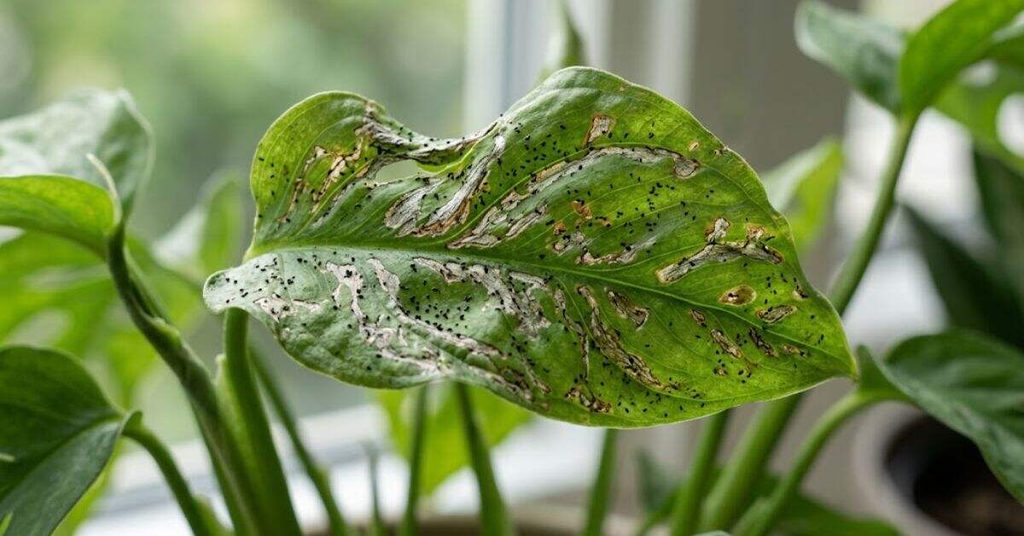
The damage often provides the first clue.
Silvery or bronzed foliage
Thrips feeding can destroy individual plant cells, leaving affected areas looking silver, pale, bronze or scraped rather than simply yellow. On some leaves, the damage resembles a thin layer of metallic dust.
As the injury ages, those areas may become brown or papery.
Black specks on damaged tissue
Look closely at the pale areas for small dark dots. These can be thrips fecal spots, sometimes appearing almost like tiny drops of black ink.
That combination—silvering plus dark specks—is more useful diagnostically than either symptom alone.
Distorted young growth
Thrips often target tender tissue. As a result, emerging leaves may curl, become misshapen or develop irregular scars.
Flowers can also show pale flecks, damaged petals or poor opening when feeding occurs inside developing buds.
A simple confirmation test
Hold white paper beneath a suspicious flower or shoot and tap it gently. A magnifying lens makes the inspection easier, but movement is often the giveaway: thrips look like tiny, fast-moving threads rather than round insects.
If you only see old silver scars and no active insects, don’t automatically assume the infestation is still severe. The plant may be carrying old damage from a population that has already declined.
Where Thrips Hide on a Plant
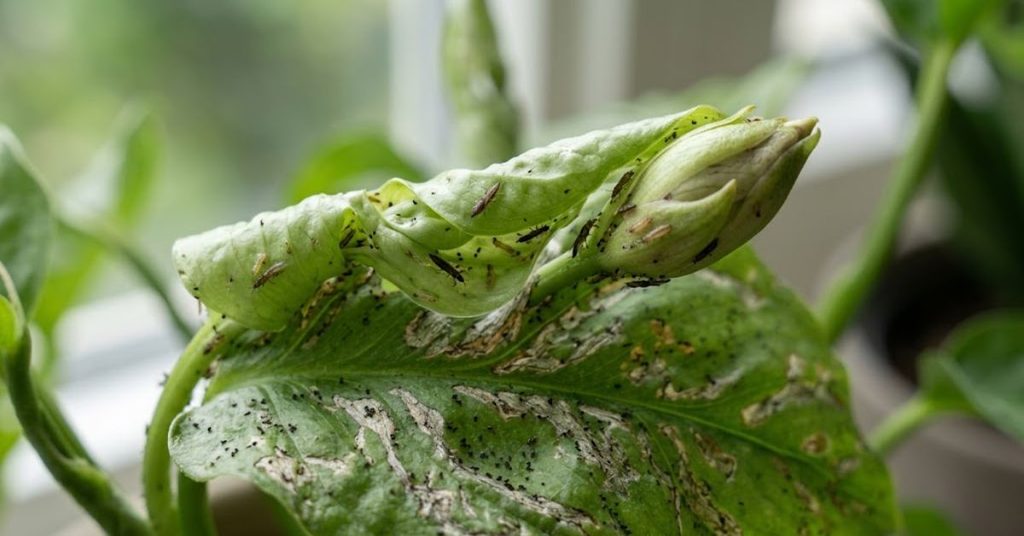
Knowing where to look can save more time than repeatedly increasing the strength of a treatment.
Check these areas first:
- Newly unfurling leaves
- Flower buds
- Inside open flowers
- Leaf undersides
- Tight leaf folds
- Shoot tips
- Crevices around stems
- Fallen plant debris
- Potting media around affected plants
The reason this matters is simple: a spray that thoroughly coats an exposed leaf cannot automatically reach an insect hidden deep inside a flower or protected within plant tissue.
The developmental cycle also includes stages that are not continuously exposed on foliage. UC IPM notes that many thrips species move through feeding larval stages followed by prepupal and pupal stages, with later stages often occurring in soil, leaf litter or sheltered plant locations.
Why Thrips Keep Coming Back
A plant can appear dramatically better after treatment and still develop fresh damage later.
That doesn’t necessarily mean the treatment failed.
It can happen because the population wasn’t present in one location or one life stage. Adults and larvae may be exposed on foliage while other stages are protected elsewhere. In addition, eggs may be inserted into plant tissue, making them difficult to reach with a surface treatment.
Warm conditions can speed up development. UC IPM reports that some thrips can complete their life cycle in roughly two weeks under favorable conditions, while the RHS gives approximately 24–35 days for a typical thrips life cycle under ideal conditions depending on species and environment.
Therefore, think in terms of breaking a population cycle, not winning a single spraying session.
First Response: Isolate, Inspect, and Wash
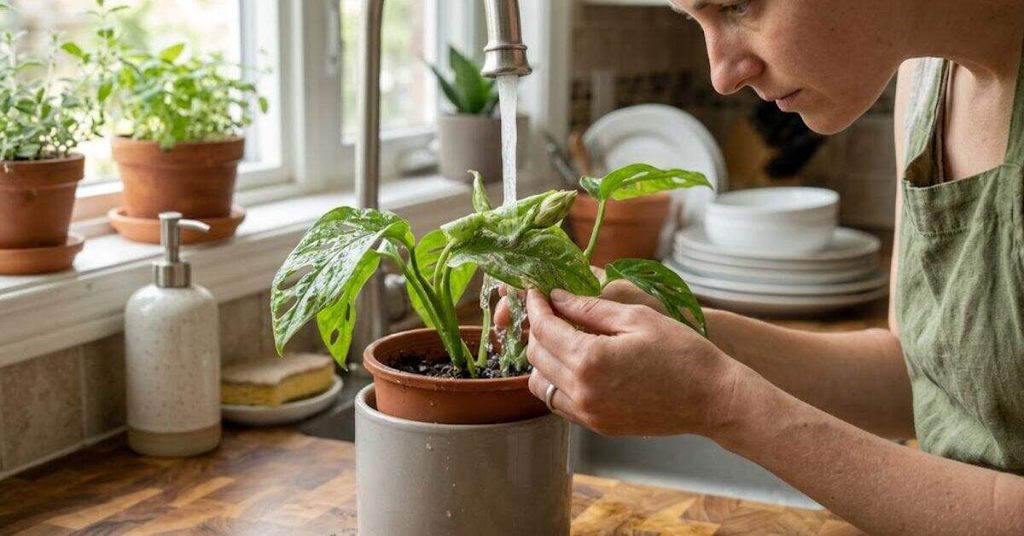
For an indoor plant, isolation should come before complicated treatment.
Move the affected plant away from healthy plants and inspect nearby plants as well. Pay particular attention to plants sharing the same shelf, window area or growing space.
Next, use water to physically remove exposed insects. A firm but plant-safe stream can dislodge thrips from foliage, especially on sturdy plants. UC IPM specifically includes washing as a useful houseplant control measure.
Don’t use enough force to tear leaves or damage delicate flowers. The goal is to remove pests, not create additional wounds.
After washing, allow the foliage to dry appropriately for the plant before moving to any labeled spray treatment.
Pruning Damaged Tissue
Pruning is useful when a flower, shoot or leaf is heavily damaged and likely to contain hidden insects.
However, don’t strip the plant simply because a leaf has cosmetic scars.
A leaf that is mostly green can still contribute energy to the plant. Removing every marked leaf may leave the plant weaker than the original pest problem did.
Instead, prioritize:
- Severely distorted shoot tips
- Heavily infested flowers
- Completely damaged leaves
- Tissue containing obvious clusters of insects
Dispose of heavily infested material rather than leaving it beside the plant.
Sticky Traps for Monitoring
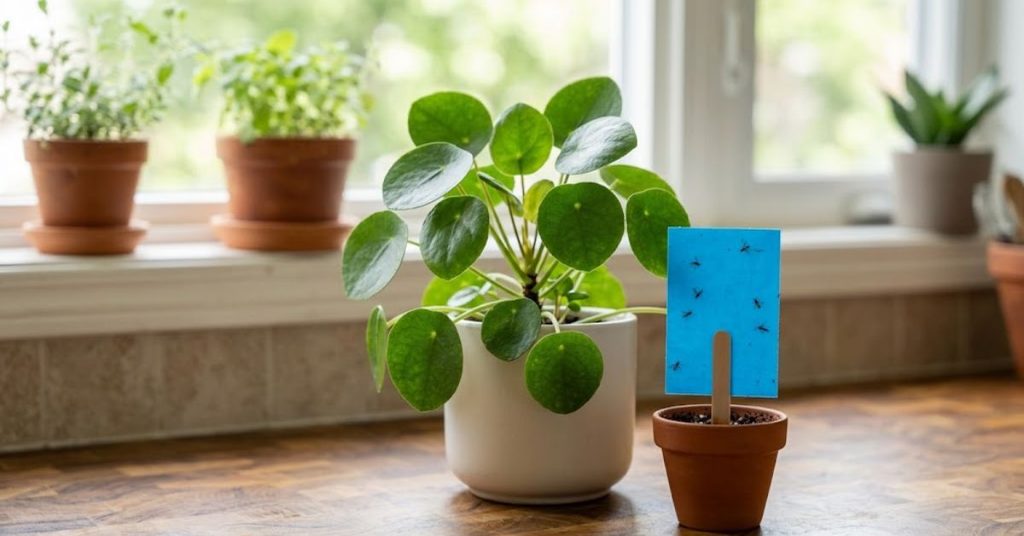
Sticky cards are especially useful because they answer a question that visual inspection often cannot:
Is the adult population increasing or decreasing?
Blue sticky traps are commonly used for thrips monitoring, and both RHS and university sources recognize their usefulness, particularly in protected growing environments.
However, sticky traps shouldn’t be treated as the entire solution. They mainly help intercept mobile adults. They don’t replace inspection of leaves, flowers and growing points.
For an indoor collection, place traps close enough to the plant to monitor activity without letting them become a nuisance.
Insecticidal Soap and Horticultural Oil
Contact treatments can be useful when the product is labeled for thrips and your particular plant.
The important word is contact.
The product needs to reach the pest. If thrips are buried inside a flower or tucked into an inaccessible fold, a beautifully sprayed outer leaf doesn’t solve that particular problem.
UC IPM lists insecticidal soap and horticultural oil among options for houseplant thrips.
Always follow the product label for concentration, compatible plants, application frequency and precautions. Test a small area first when the label or plant sensitivity makes that appropriate.
Never assume that a homemade soap mixture is equivalent to a formulated insecticidal soap.
Neem Oil and Plant Oils
Neem-based products and other plant oils are sometimes used against thrips, but they should not be viewed as a magic cure.
Their effectiveness depends heavily on coverage and timing. Hidden insects can survive if the treatment never reaches them, while eggs protected inside plant tissue won’t necessarily be eliminated by a surface application.
If you choose a neem or plant-oil product, use one that is legally labeled for the intended pest and plant, and follow its directions exactly.
Also avoid treating plants in stressful heat or direct intense sunlight unless the product label specifically permits those conditions.
Spinosad: A Different Treatment Option
Spinosad is another active ingredient used in some thrips-control products.
Unlike simply washing insects away, a properly labeled spinosad product can provide a different mode of action. However, availability, legal registration and permitted uses vary by country and product.
That means the correct advice is not “always use spinosad.” Instead, check the local product label and use only according to its directions.
For flowering plants, also consider pollinator exposure. Avoid indiscriminate spraying of open blooms, and follow all label restrictions concerning bees and other beneficial insects.
Biological Control for Persistent Infestations
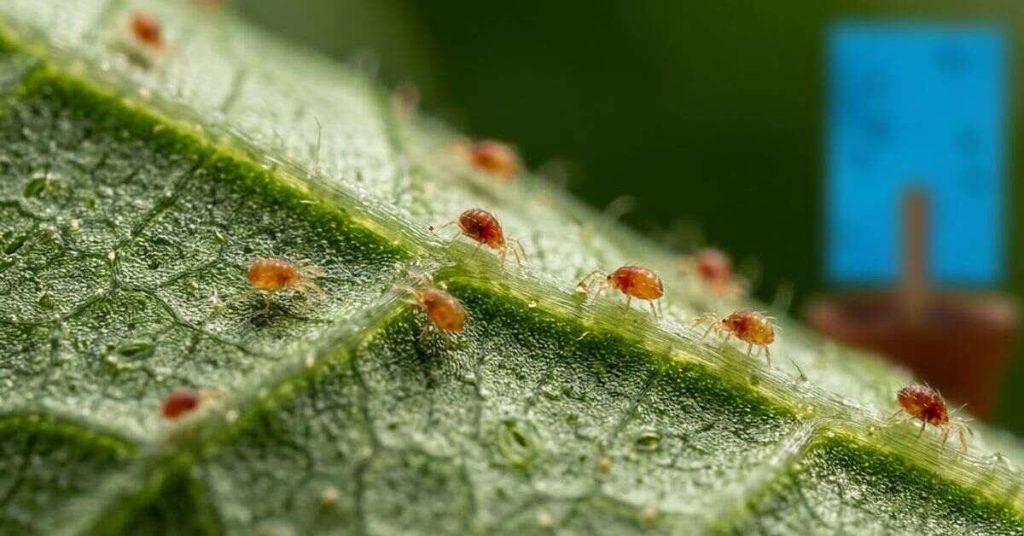
Biological control can be particularly interesting for greenhouses and serious indoor growing collections.
Useful organisms include predatory mites, minute pirate bugs and other beneficial predators. RHS lists organisms such as Orius species and predatory mites among biological-control options for thrips.
The major advantage is that biological control attacks the pest as part of a living system rather than relying entirely on repeated pesticide applications.
The drawback is that predators have their own environmental requirements. They also can be harmed by pesticides, so combining biological control with incompatible sprays can undermine the strategy.
The PlantGuideCare Thrips Reset Method
Instead of treating every infestation identically, divide the response into three jobs.
Job 1: Remove what you can see
Isolate the plant, wash exposed pests away and remove severely infested flowers or shoots.
This immediately reduces the visible population.
Job 2: Find what the first treatment cannot reach
Inspect flowers, young leaves, growing points and the surface around the pot.
This is where many treatment plans become more effective: you’re no longer assuming every thrip is sitting on the broad surface of a mature leaf.
Job 3: Monitor the comeback
Use sticky cards where appropriate and inspect new growth repeatedly.
Fresh, undamaged growth is particularly useful as a progress indicator. If new leaves emerge normally while old scars remain unchanged, the plant may be recovering even though the older foliage still looks unattractive.
Conversely, new silvering appearing on newly developed leaves is a warning that active feeding is continuing.
This new-growth test is one of the most practical ways for a beginner to judge progress without obsessing over every old scar.
Preventing Thrips on Plants
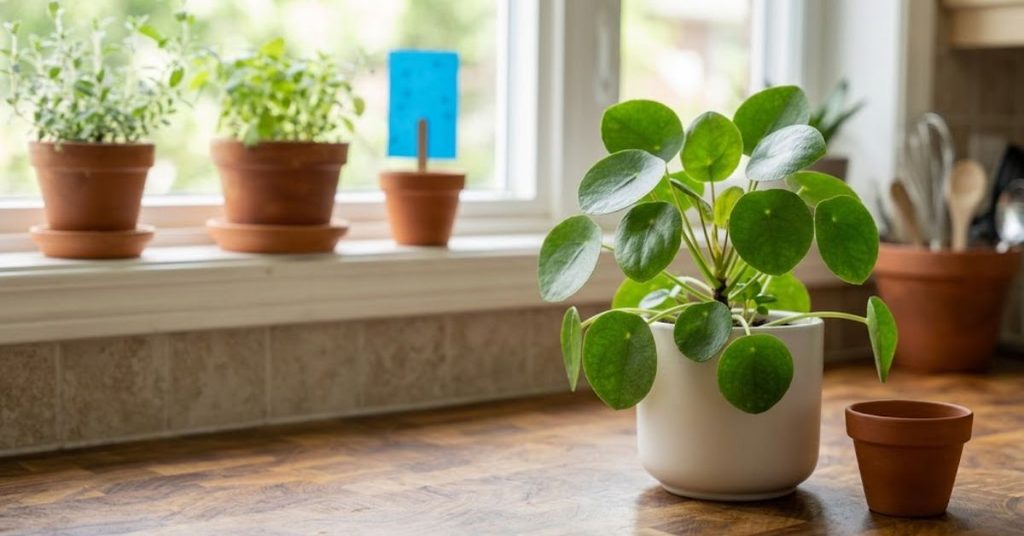
Prevention starts before a new plant reaches your collection.
Inspect new purchases carefully, especially flowers, young foliage and leaf undersides. Quarantine is particularly valuable indoors because a single unnoticed plant can expose many neighboring plants. RHS specifically recommends inspecting and quarantining new plants because pests can arrive with purchased plants.
Keep the growing area clean as well. Remove dead flowers and badly infested plant material, control weeds around outdoor plants where appropriate, and avoid creating a dense jungle of stressed plants that are difficult to inspect.
Healthy growth doesn’t make a plant immune, but good cultivation makes it easier to spot changes early.
Common Problems & Fixes
Silver scars remain after treatment: Old damage will not turn green again. Judge success by the condition of newly emerging foliage rather than the appearance of already damaged tissue.
Black dots are present but no insects are visible: Inspect flowers, folds and growing tips more carefully. The dots may be evidence of earlier or current thrips activity, but they are not by themselves proof of a large active population.
The plant looks better and then new damage appears: A later life stage may have survived the first treatment. Restart careful monitoring and follow the label schedule of any treatment you are using rather than repeatedly increasing the dose.
Leaves are curling: Thrips can distort young tissue, but curling can also result from watering problems, heat stress, mites or environmental changes. Look for the characteristic silvering and black fecal spots before blaming thrips.
Sticky traps are full of insects: Traps are useful monitoring tools, but the number caught doesn’t automatically tell you how much plant damage is occurring. Inspect the plant itself and watch whether fresh damage is developing.
The plant is heavily damaged: Remove the worst tissue, isolate the plant and decide whether the remaining healthy growth is worth saving. A plant with a strong root system and several healthy growing points can often recover even after severe cosmetic damage.
FAQ: Thrips on Plants
Q1: What do thrips on plants look like?
Ans:Thrips are very small, narrow insects that may appear yellow, brown, black or pale depending on species and life stage. Adults can have narrow fringed wings, while immature stages are generally smaller and wingless.
Q2: What is the easiest way to confirm thrips?
Ans:Place white paper beneath a suspicious leaf, flower or shoot and gently tap the plant. Tiny fast-moving insects may become visible against the white background, making them easier to distinguish from old leaf damage.
Q3: Do thrips live in soil?
Ans:Some developmental stages can occur in soil, leaf litter or sheltered locations rather than remaining on the plant surface. Therefore, treating only visible adults may not eliminate the entire population.
Q4: Will neem oil get rid of thrips?
Ans:Neem-based products can be part of a control strategy when properly labeled for the pest and plant. However, coverage is important, and one application should not be expected to eliminate every life stage.
Q5: Are thrips dangerous to plants?
Ans:Small populations may cause limited cosmetic injury, but larger populations can distort young growth, damage flowers and weaken susceptible plants. Some thrips species can also transmit plant viruses.
Q6: How long does it take to get rid of thrips?
Ans:There is no universal number of days because species, temperature, plant structure and treatment all affect control. Since different life stages occupy different locations, successful management usually requires repeated inspection and appropriately timed control rather than one application.
Q7: Can a plant recover from thrips damage?
Ans:Yes. Existing silver scars and distorted leaves usually won’t return to perfect condition, but a plant can produce healthy new growth after the active infestation is controlled. Watch the newest leaves for evidence of continuing feeding.
Q8: Should I throw away a plant with thrips?
Ans:Not necessarily. A valuable or otherwise healthy plant is often worth treating, especially when the infestation is detected early. However, severely damaged plants that continue declining despite sustained treatment may not justify the time and risk of spreading pests to the rest of a collection.
Final Takeaway
Thrips on plants can be frustrating because these tiny pests rarely stay in one easy-to-reach place. However, early identification makes control much easier. Look beyond the insects themselves and watch for silvery leaf damage, black fecal spots, curled new growth, and damaged flowers.
The most effective approach is to treat the infestation as an ongoing process rather than a one-time spraying job. Isolate the affected plant, remove heavily damaged tissue, wash away exposed pests, monitor adults with sticky traps, and use an appropriate labeled treatment when necessary. Because different life stages can occupy different parts of the plant and growing area, repeated inspection is just as important as the initial treatment.
Finally, don’t judge recovery by the old scars left on the leaves. Instead, watch the newest growth. When fresh leaves and flowers begin developing without new thrips damage, that’s one of the clearest practical signs that your plant is moving in the right direction.
Pingback: Lily Plant Care: Complete Growing & Care Guide