
Rubber Plant care is easiest when you focus on four things first: strong filtered light, a potting mix that drains freely, thorough watering followed by a partial dry-down, and a stable indoor location. Ficus elastica is generally forgiving, but constantly wet soil, sudden environmental changes, and insufficient light can turn an otherwise healthy plant into a leaf-dropping mess.
A quick real-home observation
A rubber plant can look perfectly healthy for weeks and then suddenly drop several leaves after a change that seemed harmless such as moving it beside a different window or increasing watering because the weather became warmer. That reaction is one reason diagnosis matters more than following a rigid seven-day schedule. The plant’s leaves, soil, pot, and location together tell you much more than the calendar does.
Rubber Plant Care at a Glance
| Care factor | Practical target |
| Light | Bright filtered or indirect light |
| Water | Thoroughly water after the upper soil has dried |
| Soil | Airy, well-draining houseplant mix |
| Temperature | Warm, stable indoor conditions; avoid cold drafts |
| Humidity | Average household humidity is usually workable |
| Toxicity | Milky sap can irritate; keep away from pets and children |
| Difficulty | Beginner-friendly |
| Botanical name | Ficus elastica |
| Family | Moraceae |
The RHS classifies Ficus elastica as a tropical evergreen and recommends bright filtered or indirect light with moist but well-drained growing conditions.
Understanding Ficus elastica
The rubber plant is a tropical evergreen tree grown indoors mainly for its broad, glossy foliage. Mature plants can become substantial indoor specimens, and the RHS lists an outdoor potential height of roughly 2.5–4 meters under suitable conditions.
The common name can also cause confusion because several plants are marketed with “rubber” in their names. The classic rubber tree discussed here is Ficus elastica, not baby rubber plant (Peperomia obtusifolia).
Popular forms include:
- Burgundy — dark green to burgundy foliage
- Robusta — large, deep-green leaves
- Tineke — cream, green, and pink-toned variegation
- Ruby — stronger pink, red, cream, and green coloring
- Decora — broad leaves with prominent pale midribs
Variegated forms generally benefit from stronger indoor light because portions of their leaves contain less chlorophyll.
Finding the Right Indoor Location
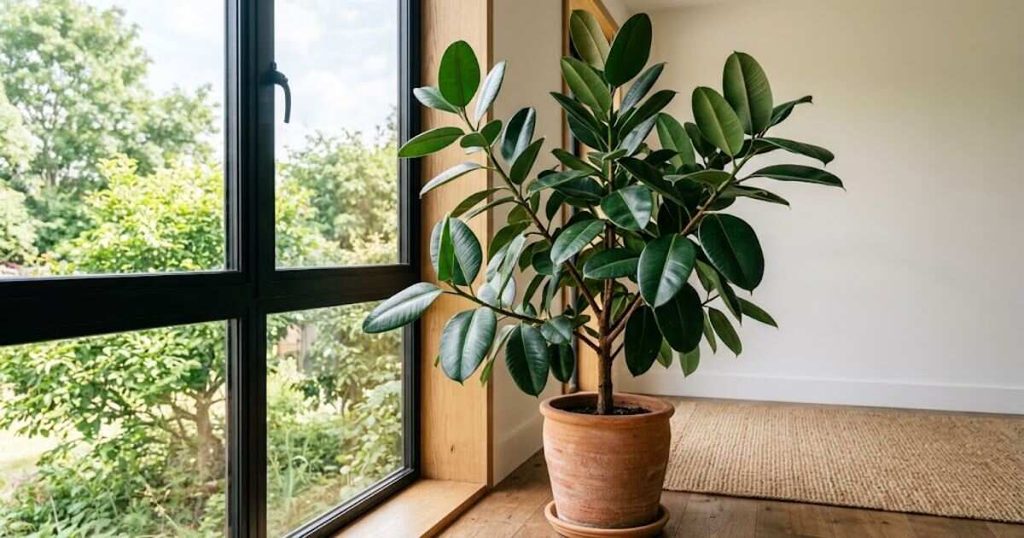
A good location solves several Rubber Plant care problems before they begin.
Place the plant near a bright east-facing window, or position it farther back from a stronger south- or west-facing window where the afternoon rays are softened.
Watch the foliage rather than judging the window alone.
Too little light may produce:
- Long spaces between leaves
- Slow new growth
- Smaller new leaves
- A plant leaning toward the window
- Loss of strong variegation
Too much harsh sun may produce:
- Pale or bleached patches
- Dry brown areas
- Crispy sections on exposed leaves
- Sudden stress after moving from shade into intense sun
A rubber plant that has lived in a dim room should not be transferred directly into intense midday sunlight. Increase exposure gradually so the foliage has time to adjust.
Keep the plant’s position reasonably stable
Rubber plants do not need to be treated like delicate museum pieces, but repeatedly moving them between very different environments can create unnecessary stress.
For example, moving a plant from a bright window to a dark hallway and then back to the window changes both its light level and watering rate. Instead, choose a location where the plant receives consistent usable light and leave it there unless there is a clear problem.
Watering Established Rubber Plants
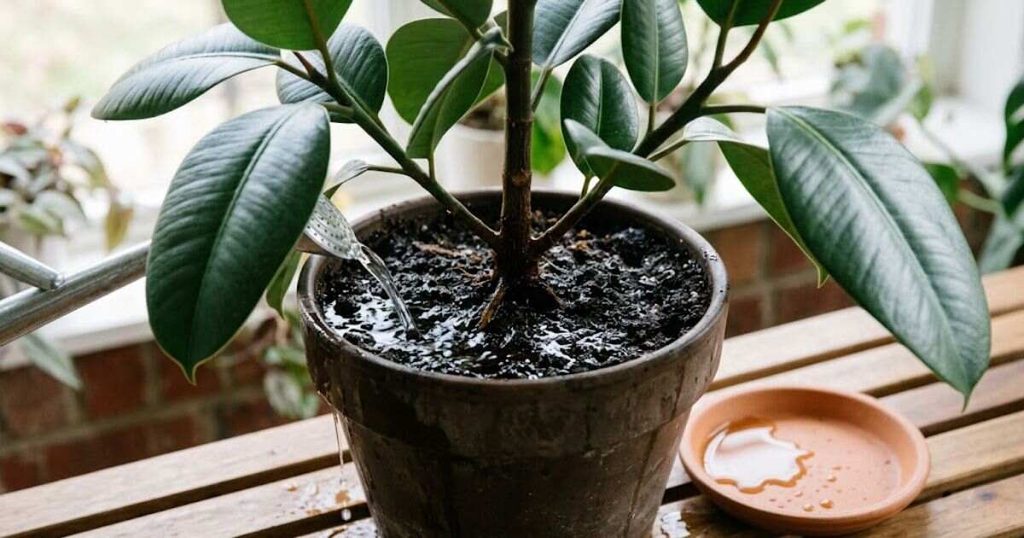
Forget the idea that every rubber plant needs water on the same weekday.
Instead, inspect the pot.
Push your finger into the upper soil. If the surface and upper portion still feel noticeably damp, wait. If the mix has dried enough to need water, soak the root ball thoroughly and allow excess water to escape.
The important sequence is:
check → water thoroughly → drain → wait for another partial dry-down.
Do not give the plant a small splash every day. Frequent shallow watering can leave different parts of the root zone at inconsistent moisture levels while the pot remains poorly aerated.
Adjust watering to the room
A rubber plant beside a bright, warm window may dry much faster than the same-sized plant in a cool corner.
The watering interval changes with:
- Pot diameter
- Soil composition
- Drainage-hole size
- Light exposure
- Indoor temperature
- Season
- Plant size
- Root density
Therefore, a calendar can be a useful reminder to check the plant, but it should not decide whether the plant actually receives water.
Soil and Drainage
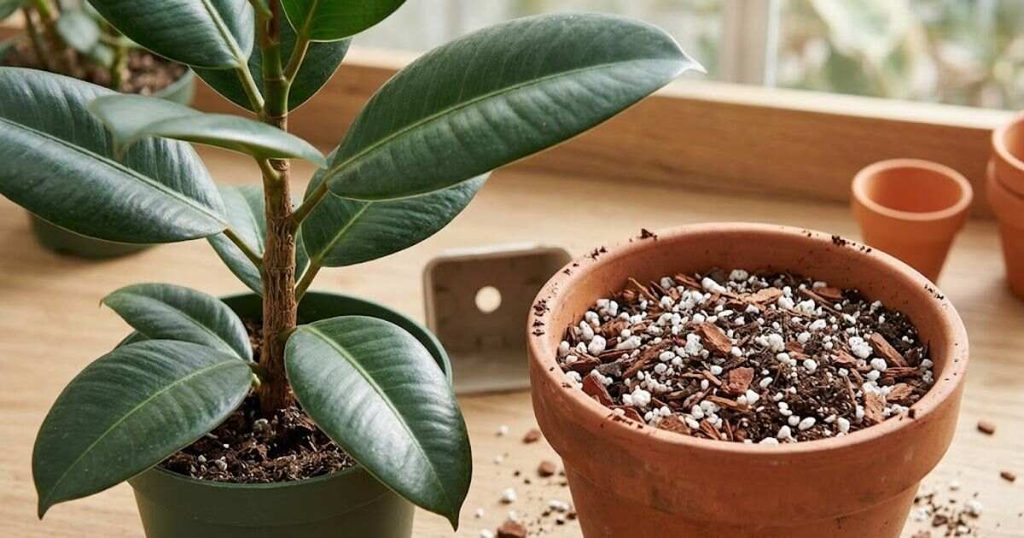
The ideal rubber plant mix does two jobs simultaneously: it holds enough moisture for the roots while allowing excess water and air to move through the container.
A simple homemade approach is:
- About 2 parts quality indoor potting mix
- 1 part perlite
- 1 part fine pine bark
The exact recipe does not need to be treated as a laboratory formula. The goal is a mix that does not collapse into dense mud after repeated watering.
A container must also have functioning drainage holes.
If water takes a long time to disappear from the surface, the problem may not be that you are “watering too much.” The real issue could be compacted soil, poor drainage, or a container that holds more moisture than the plant can use.
Temperature and Humidity
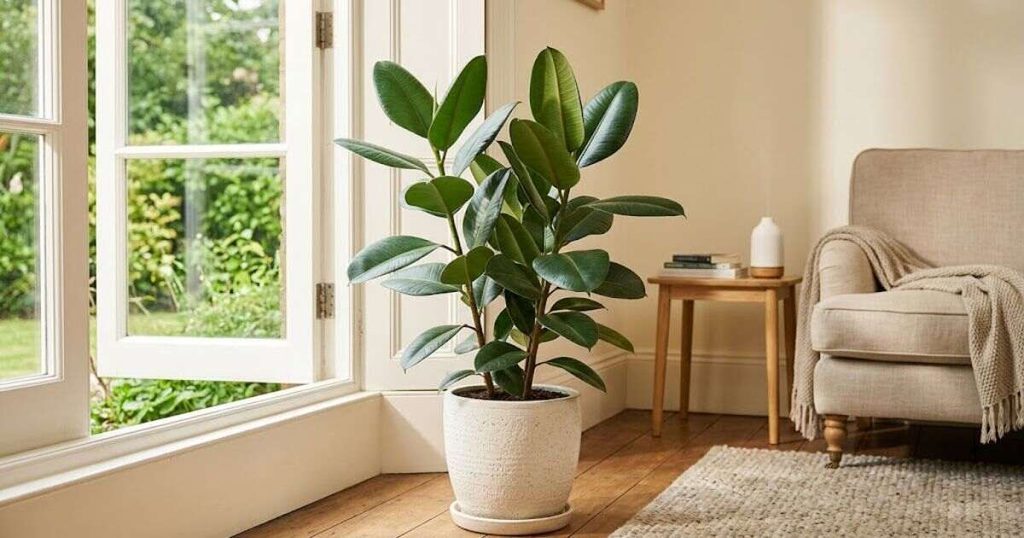
Rubber plants prefer warm, relatively stable indoor conditions.
Clemson Extension recommends avoiding temperatures below 55°F (about 13°C) as well as sudden temperature drops and cold drafts.
Keep the plant away from:
- Air-conditioning outlets
- Strong heater airflow
- Frequently opened cold doors
- Very cold windows during winter
- Sudden temperature swings
Humidity is slightly more forgiving than many beginners expect. A normal home can work, provided the foliage is not constantly exposed to extremely dry moving air.
If brown tips repeatedly appear while watering and lighting are appropriate, check whether the plant sits directly beside a heater or strong ventilation source.
Feeding a Growing Rubber Plant
Fertilizer should support active growth rather than compensate for poor lighting or unhealthy roots.
During the brighter growing months, a balanced liquid houseplant fertilizer diluted according to its label can be used periodically.Reduce feeding frequency or pause it entirely during periods of minimal or halted growth.
Avoid increasing fertilizer because the plant is growing slowly.
If the plant is sitting in a dark corner, adding more nutrients does not solve the underlying shortage of light. Instead, excess fertilizer can contribute to salt accumulation in the potting mix.
Think of fertilizer as fuel, not a replacement for sunlight.
Cleaning Those Large Leaves
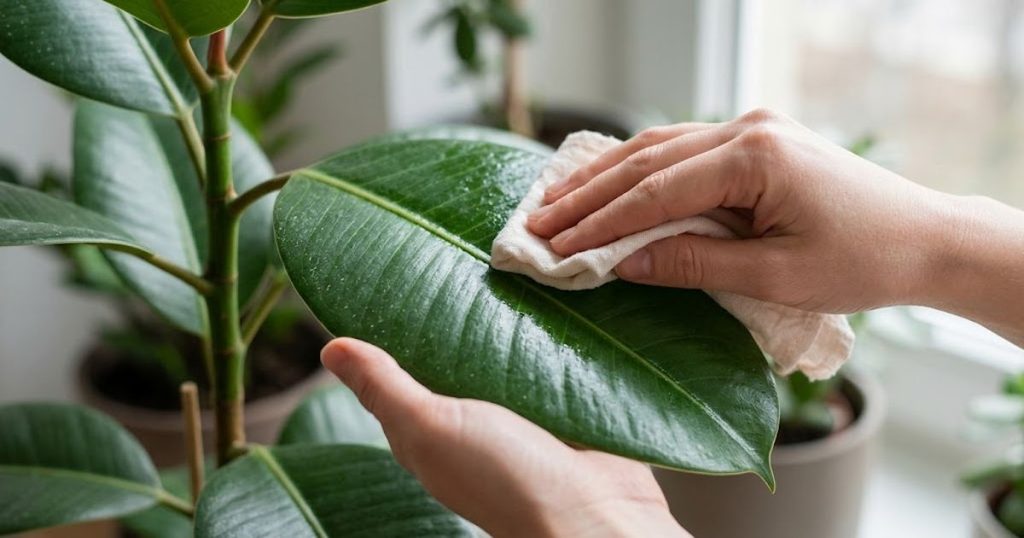
The broad leaves are one of the main reasons people choose Ficus elastica, but those same large surfaces collect dust.
Every few weeks, inspect the leaves under normal room lighting. If you can visibly see a dusty film, gently wipe the foliage with a soft, damp cloth.
Support the leaf underneath rather than dragging aggressively across it.
Refrain from using commercial oil-based leaf shines, as they can clog stomata and impede plant respiration. A clean leaf surface is enough; the plant does not need a glossy coating.
Cleaning also gives you an excellent opportunity to inspect the undersides for scale insects, mealybugs, or mites.
Pruning for a Bushier Shape
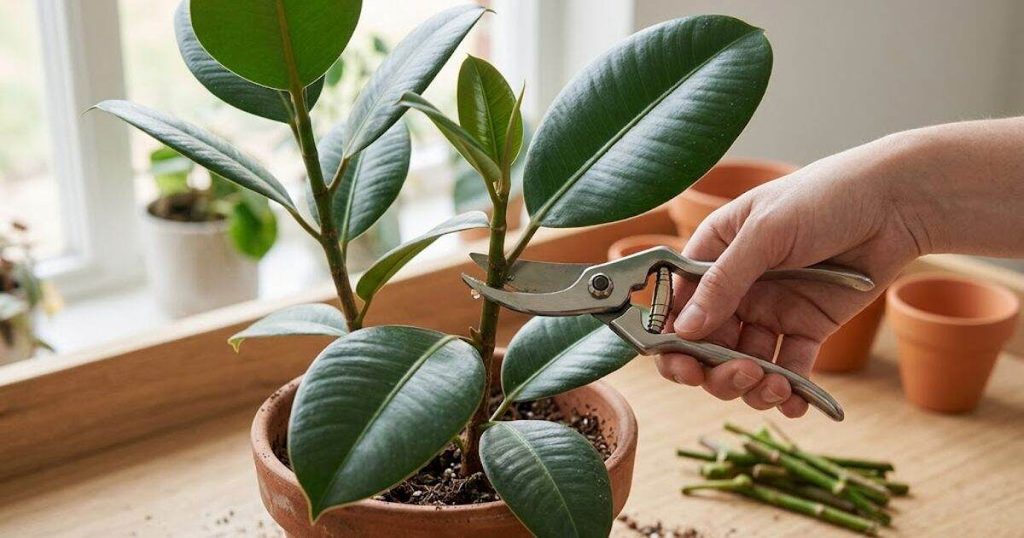
A young rubber plant often wants to grow upward before it starts producing the branching structure people expect from a full indoor tree.
Pruning can change that shape.
If a plant has become too tall or has developed a single dominant stem, make a clean cut above a suitable growth point. New growth can then develop below the cut rather than continuing exclusively from the original top.
Before pruning, prepare:
- Clean, sharp pruning shears
- Gloves
- A protected work surface
- A place to keep pets and children away from the fresh cut
The milky latex-like sap can irritate skin, so avoid touching your face after handling freshly cut stems.
Repotting Without Creating a New Problem
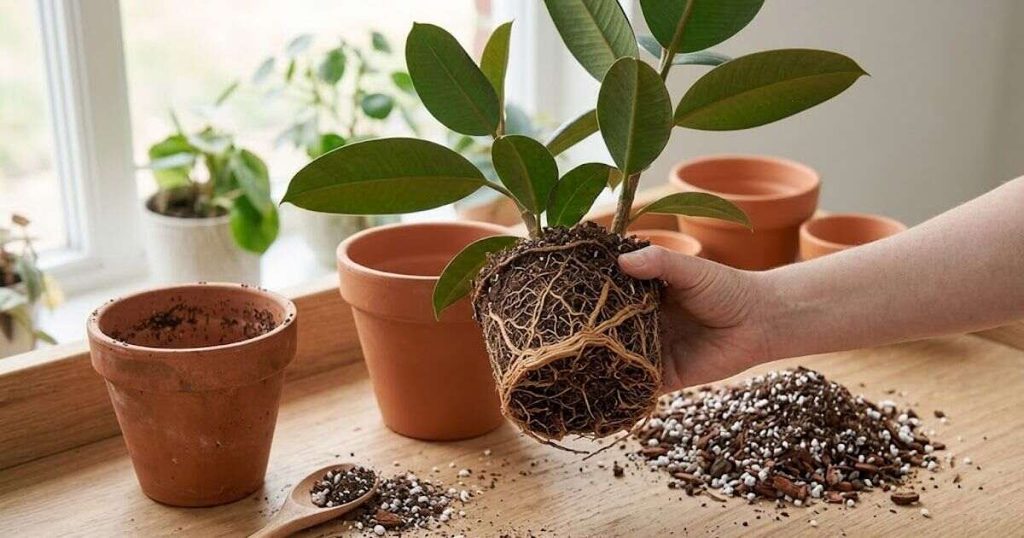
Repot when the root system has clearly outgrown its current container or the potting mix has deteriorated.
Signs include:
- Roots circling heavily around the root ball
- Water racing through the pot unusually quickly
- Roots emerging from drainage openings
- The plant becoming unstable
- Soil becoming difficult to re-wet evenly
Do not automatically choose a dramatically larger container.
A huge pot contains a much larger volume of soil, and that soil can remain wet around the roots for longer than expected. A moderately larger container is usually easier to manage.
After repotting, place the plant back into a bright, stable location and monitor moisture rather than automatically increasing the watering frequency.
Propagating Ficus elastica
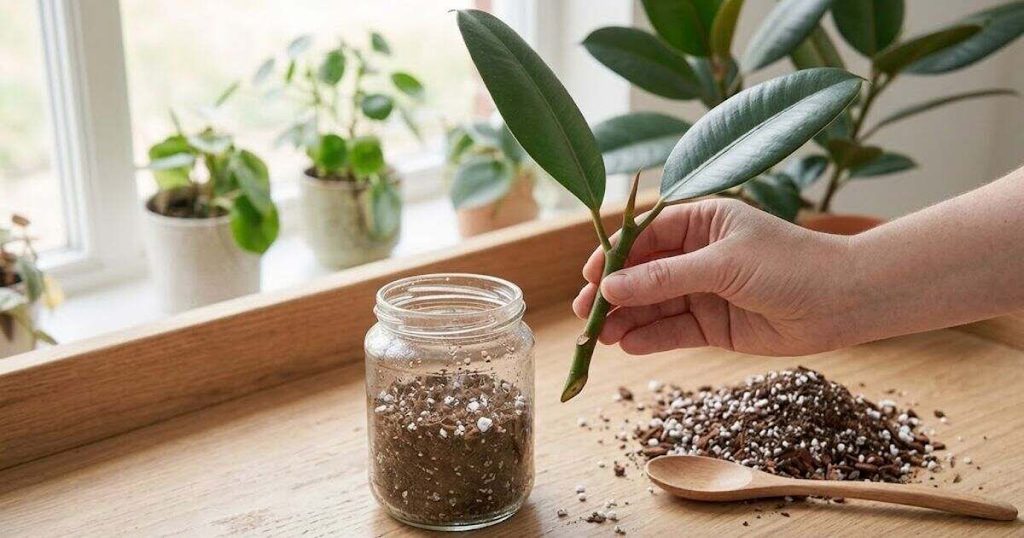
Rubber plants can be propagated from stem material, while air layering is another useful technique for larger woody specimens.
Stem cuttings
Choose healthy stem material containing a viable node. Allow the cutting method and rooting medium to match the size and condition of the cutting.
Keep the medium lightly moist rather than saturated, and provide warmth and bright indirect light.
Air layering
Air layering is especially useful when you want to create a new plant from a substantial stem while it is still attached to the parent.
The method encourages roots to form on the selected section before that section is separated.
The RHS lists semi-ripe cuttings and layering among propagation methods for Ficus elastica.
The Rubber Plant Decision Map: Diagnose Before You Change Care
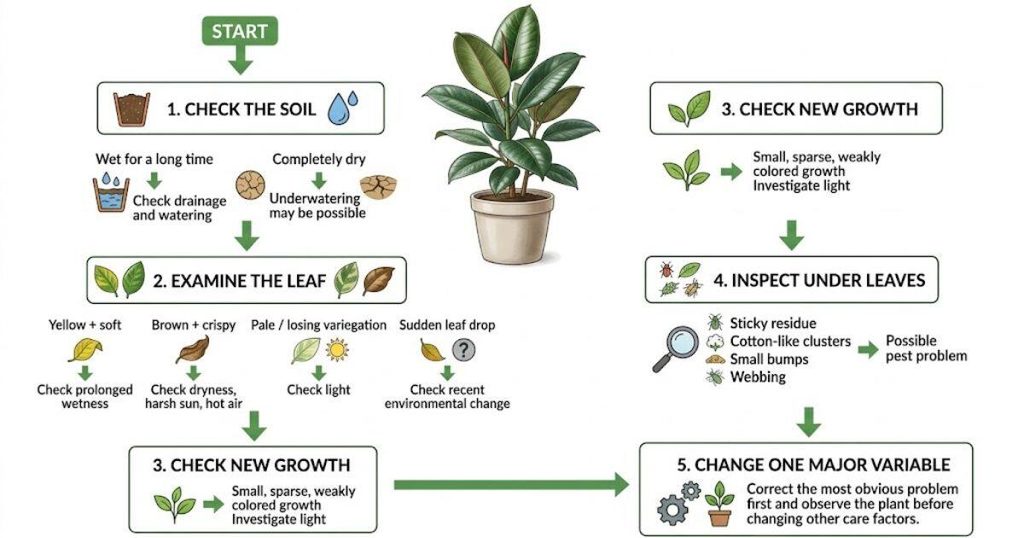
This is the step many basic Rubber Plant care guides miss.
Before changing three things at once, inspect the plant in this order.
Step 1: Touch the soil
Wet for a long time?
Investigate drainage and watering frequency before adding more water.
The potting mix is completely dry and has contracted away from the sides of the container?
Underwatering becomes more plausible.
Step 2: Examine the leaf
Yellow and soft?
Check for prolonged wetness around the roots.
Brown and crispy?
Check dryness, harsh sunlight, and hot moving air.
Pale or losing variegation?
Check light levels.
Suddenly dropping healthy-looking leaves?
Look for a recent move, temperature change, draft, or major change in watering.
Step 3: Inspect the newest growth
New leaves tell you about the plant’s current environment better than an old damaged leaf does.
If new leaves are increasingly small, sparse, or weakly colored, investigate light before reaching for fertilizer.
Step 4: Inspect underneath the leaves
Look closely along the midrib and leaf joints.
Sticky residue, cottony clusters, small bumps, webbing, or unusual speckling can indicate pests.
Step 5: Change one major variable first
If you discover low light and excessive watering, do not randomly change fertilizer, humidity, soil, light, and pot size all on the same day.
Correct the most obvious problem first and observe the plant’s response.
That makes diagnosis much easier.
Common Problems & Fixes
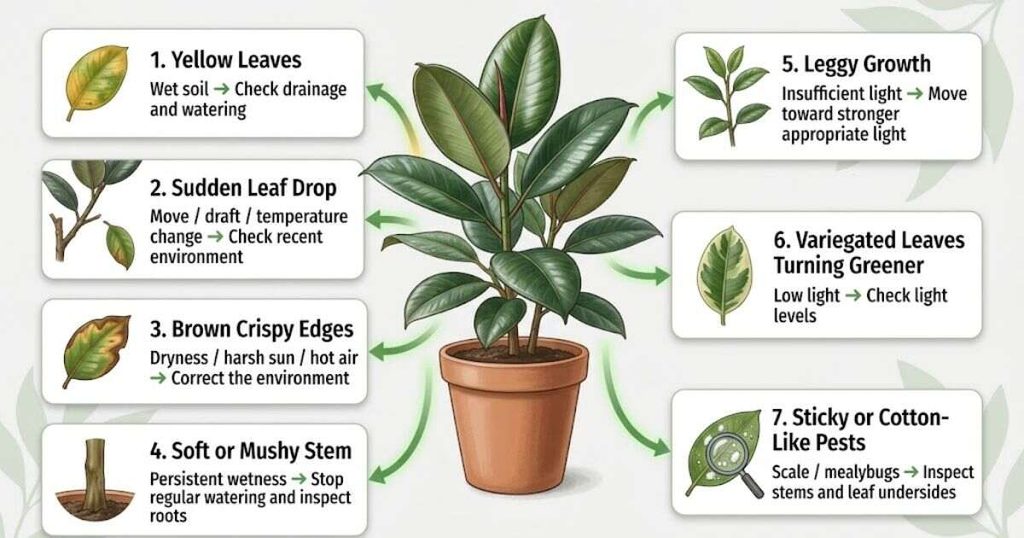
Yellowing leaves:
If several leaves turn yellow while the potting mix remains wet for long periods, inspect drainage and watering habits first. Older individual leaves can also yellow naturally, so look at the pattern rather than reacting to one leaf.
Leaves dropping suddenly:
Check for a recent relocation, cold draft, major temperature change, low light, or watering problem. Sudden environmental changes can be especially noticeable in ficus plants.
Brown crispy edges:
Check whether the soil has become extremely dry, the plant receives intense direct sun, or hot dry air blows directly across the leaves. Correct the environmental cause rather than simply trimming the brown section.
Soft or mushy stem:
Cease regular watering immediately and examine the root system for signs of damage or rot. Persistent saturation can damage roots and eventually affect the stem.
Leggy growth:
Move the plant toward a stronger source of appropriate light. Pruning can improve the shape, but it cannot replace insufficient light.
Variegated leaves turning greener:
Check the light first. Variegated Ficus elastica generally needs enough usable light to maintain strong coloration.
Sticky or cotton-like pests:
Inspect stems, leaf joints, and undersides. Scale and mealybugs are among the pests reported on rubber plants.
Leaves covered in dust:
Use a soft damp cloth and support each leaf while wiping. Clean foliage is also easier to inspect for early pest activity.
Is a Rubber Plant Safe Around Pets?
Treat Ficus elastica as a plant that should be kept away from pets that chew foliage.
Pet Poison Helpline specifically identifies Ficus elastica as the rubber tree plant and notes that its sap contains an irritating substance; ingestion can cause oral irritation and gastrointestinal signs such as drooling, retching, or vomiting.
The milky sap can also irritate human skin, so gloves are sensible when pruning or handling damaged stems.
If a pet has chewed the plant, contact a veterinarian or an appropriate animal poison service rather than trying to diagnose the severity yourself.
Choosing a Rubber Plant Variety
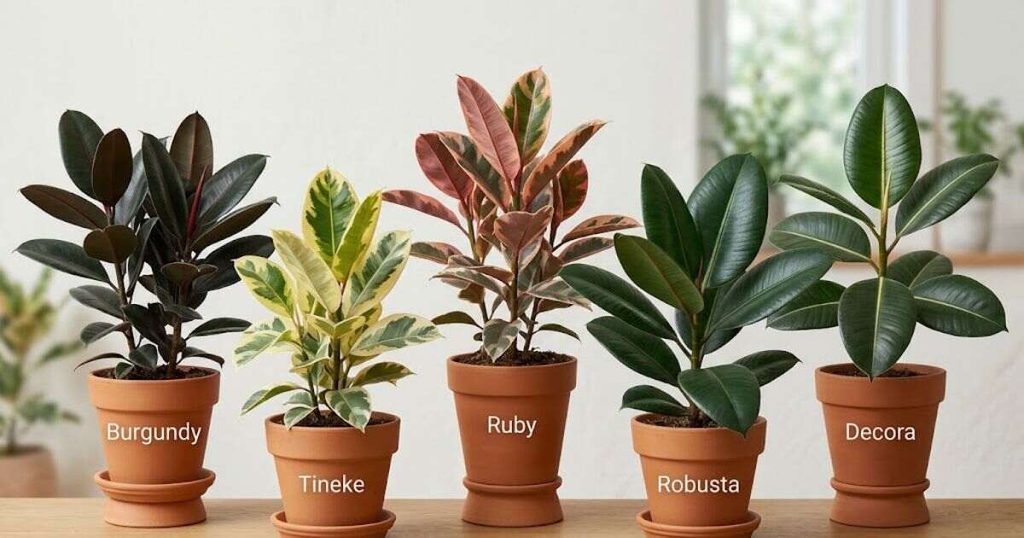
If you’re buying your first Ficus elastica, the variety can influence how the plant looks in your room.
Burgundy:
A strong choice when you want deep, dark foliage with a dramatic appearance.
Tineke:
Cream-and-green variegation creates a brighter visual effect, but adequate light is especially important for maintaining the pattern.
Ruby:
Known for stronger pink and red tones mixed with green and cream.
Robusta:
Classic large, dark-green foliage with a bold indoor-tree appearance.
Decora:
Broad leaves and a noticeable pale midrib give this cultivar a traditional rubber-tree look.
The RHS lists multiple Ficus elastica cultivars, including Tineke, Robusta, and Decora, with mature plants capable of becoming substantial specimens.
Frequently Asked Questions
Q1: How frequently does a Rubber Plant need to be watered?
Ans: Check the soil instead of following a fixed weekly schedule. Water thoroughly once the upper portion has dried enough, then let excess water drain completely.
Q2: What light does a Rubber Plant need?
Ans: Bright filtered or indirect light is a reliable indoor target. Gentle morning sun can work, while intense afternoon sun through hot glass may scorch foliage.
Q3: Why are leaves falling off my Rubber Plant?
Ans: Start by checking watering, light, drafts, temperature changes, and recent relocation. A sudden change in environment can cause leaf drop even when the plant looked healthy beforehand.
Q4: Can a Rubber Plant grow in low light?
Ans: It can tolerate less light than it prefers, but growth generally becomes slower and less compact. Variegated cultivars may also lose some of their visual contrast when light is inadequate.
Q5: What soil is best for Rubber Plant care?
Ans: Use an airy, well-draining indoor potting mix that retains some moisture without becoming saturated. Adding perlite and fine bark can improve drainage and structure.
Q6: How can I make my Rubber Plant bushier?
Ans: Prune the dominant stem above an appropriate growth point to encourage branching below the cut. Give the plant enough light afterward so new shoots have the energy to develop.
Q7: Can I propagate Ficus elastica?
Ans: Yes. Stem cuttings and air layering are practical propagation approaches, with air layering particularly useful for larger stems.
Q8:Is the Rubber Plant poisonous to pets like cats and dogs?
Ans: The plant’s internal sap acts as an irritant to cats and dogs if chewed, bitten, or ingested.Keep the plant out of reach and contact a veterinarian if a pet consumes part of it.
Final Takeaway
Successful Rubber Plant care is less about memorizing a watering timetable and more about reading the plant’s environment.
Give Ficus elastica bright filtered light, an airy root zone, thorough but appropriately timed watering, stable temperatures, and enough room to grow. Then use the leaves and soil as your diagnostic tools.
If something goes wrong, don’t immediately change everything. Check soil first, light second, recent environmental changes third, and pests fourth. That simple sequence can prevent many common rubber plant problems from becoming much bigger ones.
Pingback: When Do Magnolias Bloom? Species & Bloom Times